
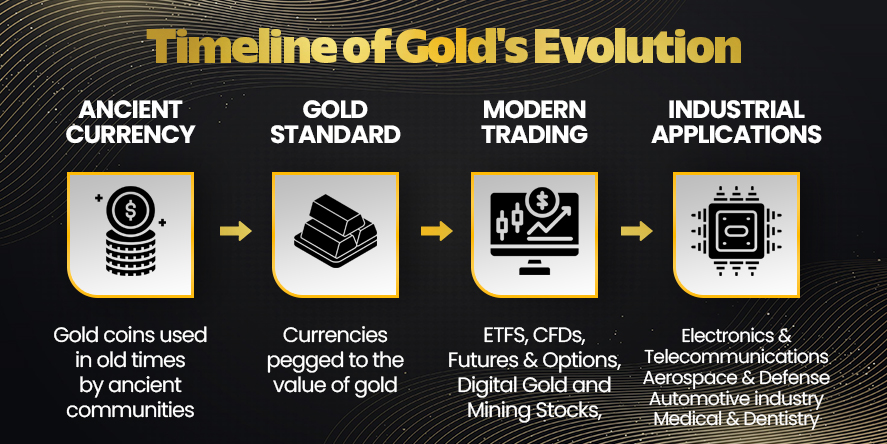
Gold has been valued for thousands of years, long before modern financial systems evolved. Ancient civilisations such as Mesopotamia, Egypt, and Rome used gold as currency, jewellery, and a store of wealth and security. Its rarity, durability, and malleability made it ideal for trade. By the time of the Roman Empire, gold coins were widely minted and circulated, embedding gold into the foundations of global commerce. Later, during the Gold Standard era (19th–20th centuries), gold became the backbone of monetary systems, with currencies pegged to its value. This cemented gold’s role as a universal trading commodity and a measure of economic stability.
Gold’s journey from ancient coins to modern ETFs (Exchange Traded Fund) has not lost its shine and reflects its timeless appeal. It is more than a shiny metal—it has value, a hedge against uncertainty, and a critical industrial resource. In India, gold is very dear to Indian households, both in the form of jewellery and bullion.
Today, its price responds to tariffs, geopolitical tensions, central bank policies, and currency movements, while its industrial uses in semiconductors, IA systems, and EV batteries ensure continued relevance in the technological age. Gold undergoes all the twists and turns of trade.
For all we know, gold remains a paradox: It is both ancient and futuristic, ornamental and industrial, and financial and scientific. Its enduring significance lies in this duality—anchoring economies while powering innovation.
An analyst’s viewpoint
As geopolitical uncertainty increases, there are signs of growing investor demand for physical assets for Gold. “We see upside risk to our $5,400 Dec26 forecast from private sector diversification. We estimate that every 1bp increase in the gold share of US financial portfolios–driven by incremental purchases–raises prices by 1.5%,’’ according to researchers from Goldman Sachs.
For a better understanding of how the gold trades across exchanges and the retail market, here is a lowdown.
Major Gold Trading Hubs & Markets
Gold today is traded in multiple forms across global markets. The major Global Gold Trading Hubs & Exchanges:
- London Bullion Market Association (LBMA – OTC): The largest global centre for wholesale OTC transactions and the industry standard for physical gold delivery.
- COMEX (CME Group – New York): The world’s largest exchange for gold futures and options, providing high liquidity.
- Shanghai Gold Exchange (SGE – China): The primary physical trading platform in China, facilitating both spot and futures trading.
- Tokyo Commodity Exchange (TOCOM – Japan): A leading Asian exchange for gold futures, popular with regional investors.
- Dubai Gold & Commodities Exchange (DGCX): A major Middle Eastern derivatives exchange.
- Chinese Gold & Silver Exchange Society (CGSE – Hong Kong): A historic venue for gold and silver trading.
- Multi-Commodity Exchange of India (MCX): A key exchange for gold futures in India.
- Zurich Gold Market: A significant physical gold trading and storage hub, though it operates more as an OTC market than a formal exchange.
.
Key Regional Markets
Asia: Shanghai Gold Exchange (SGE), Tokyo Commodity Exchange (TOCOM), Chinese Gold & Silver Exchange (CGSE).
Americas: COMEX, BM&F Bovespa (São Paulo) later merged with CETIP, creating B3.
Europe/Middle East: London (LBMA), Zurich, Dubai Gold & Commodities Exchange (DGCX).
The global gold market is dominated by the London Over-the-Counter (OTC) market.
.
Types of Gold Trading
Gold trading has many forms. Here is a walkthrough of the most common forms of trading:
Physical Trading
- Bars, coins, and jewellery.
- Central banks and institutions hold reserves in physical form.
- Trading doesn’t depend on a digital ledger platform.
- Ensures tangible, immediate control of risk.
Futures and Derivatives
- Contracts traded on exchanges like COMEX.
- Allow hedging against price volatility.
Exchange-Traded Funds (ETFs)
- Provide exposure to gold prices without physical ownership.
- Over-the-Counter (OTC) Markets.
- Direct transactions between institutions.
Digital Gold
- Emerging platforms using blockchain to tokenise gold ownership.
- This diversity makes gold accessible to retail investors, institutions, and governments.
- Traded in 24k purity. Often bought in smaller denominations. It can be purchased in grams or in currency. In India, Digital gold can be purchased as currency even in small denominations of 4 AED.
.
Factors Influencing Gold Price Movements
Gold’s value is decided by a complex interplay of economic, political, and financial factors such as tariff tensions, economic disruptions like during the time of the Covid-19 pandemic, massive buys by Central Banks, defensive positioning due to market volatility when ‘flight to safety’ mode sets in, speculative buying and when industrial demand spikes. Here are some factors:
- Tariffs and Trade Policies
i) Tariffs on gold imports/exports can affect local demand and pricing. For example, India’s import duties directly influence domestic gold consumption. - Geopolitical Tensions
i) Wars, sanctions, and political instability drive investors toward gold as a “safe haven.” During this phase, the prices generally shoot up. - Purchases by Central Banks (See table)
i) Central banks are major buyers and sellers of gold reserves. Their actions influence global supply and demand. - Institutional Purchases
i) Major mutual funds and sovereign wealth funds have the potential to move markets with bulk purchases. - Currency Movements
i) Gold is priced and traded in the global market in U.S. dollars; a weaker dollar typically boosts gold demand globally and vice versa. A strong dollar makes gold more expensive for other countries, reducing demand. Conversely, a weak dollar boosts gold prices. - Stock Market Trends
i) When equities fall, investors shift strategy and buy gold, thereby reinforcing its role as a hedge.
.
Stock Market Correlation
During times of equity market downturns (e.g., the 2008 financial crisis), gold prices surged. Following the 2008 meltdown, investors rushed to buy gold as a hedge against systemic risk. This dual role—both as a commodity and a financial instrument—makes gold unique compared to other traded assets. Purchases by institutional and Central Banks have a big impact. As of November 2025, Central Banks were collectively holding over 36,000 tonnes of the metal. (See Table).
How Central Banks’ policies affect global markets
Reserve Management
– Countries diversify reserves with gold to reduce reliance on foreign currencies.
Purchasing Trends
– The emerging economies like China and India have steadily increased gold reserves to insulate against volatility and risk of currency reserves.
Policy Significance
– Buying by a Central Bank usually signals long-term confidence in the yellow metal’s potential as a stabiliser.
Institutions such as the IMF also use gold in financial operations, reinforcing its systemic importance.
.
Industrial Applications of Gold and impact on prices
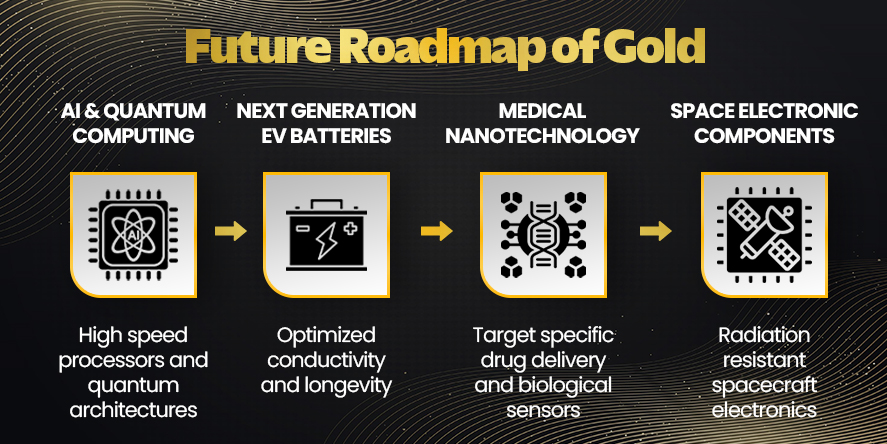
With the technology and AI going full blast, shaping everything around the ecosystem of doing business and personal lives of people, demand for chip manufacturing is increasing by leaps and bounds. While gold is best known for its financial role, its industrial applications are becoming increasingly vital. In the Information and Automation (IA) industry, Gold’s conductivity and resistance to corrosion make it essential in connectors, sensors, and precision instruments. So, the demand for the metal goes up. Key areas and industrial sectors where gold is used are as follows:
- Semiconductor Sector
In this sector, gold is used in bonding wires, thin films, and high-performance chips. Its reliability ensures stable performance in critical electronics. So, the demand for gold by this sector goes up. - Electric Vehicle (EV) Batteries
Countries around the world are racing against time to contain any further damage to the environment, and researchers are exploring the use of gold nanoparticles in battery technology. Gold has high potential to improve conductivity and efficiency in advanced battery designs. Here, the gold plays a dual role: not only as a financial hedge but also as a technological enabler. Therefore, the demand rises and as a result prices shoot northward.
.
Gold for Emerging Technology
- Space Electronics
As the race for Space competition is gathering thrust, demand for the yellow metal is increasing. Some countries are allowing private sector entry into this segment and India is one of them. Gold, in this area, is needed for developing radiation-resistant spacecraft electronics.
2. Medical Nanotechnology
As medical science is embracing hi-tech in drug delivery, robotic surgeries, and deploying AI solutions for health management and diagnosis, it requires gold to develop the latest chips to support various devices. So, gold demand spurts and in turn makes prices oscillate.
3. AI, Quantum Computing & Cloud Computing
AI applications drive gold use in this segment of technology. Demand in this sector also boosts the prices of gold.
Gold in Times of Crisis
Gold’s reputation as a “crisis commodity” is well known: Some factors that make gold indispensable are:
Inflation Hedge
- Gold retains value when fiat currencies lose purchasing power.
Crisis Insurance
- During wars, pandemics, or recessions, gold demand spikes.
Universal Value
- Unlike currencies, gold is universally recognised and accepted.
Gold, as a true precious metal, is gaining ground in every walk of life, be it personal life, industrial use, as a metal for hedging, a safe haven, as a security instrument and as a cushion in times of crisis. “When you think of gold, it’s the standard that holds value for all time.”
| GOLD RESERVES HELD BY 10 BIG COUNTRIES* | |
| United States of America | 8,133.5 tonnes |
| Germany | 3,350.3 tonnes |
| International Monetary Fund | 1,814.0 tonnes |
| Italy | 2,451.9 tonnes |
| France | 2,437.0 tonnes |
| Russian Federation | 2,326.5 tonnes |
| China, PR Mainland | 2,306.3 tonnes |
| Switzerland | 1,039.9 tonnes |
| India | 0,880.2 tonnes |
| Japan | 0,846.2 tonnes |
| WORLD GOLD HOLDINGS**: 36,520.7 tonnes (As of November 2025) | |
| European Area, including ECB: 10,765.2 tonnes (As of October 2025) | |
Source: World Gold Council. *As of February 2026. **According to the IMF’s International Financial Statistics as of February 2026.
.
Article by: Imtiaz Ahmed Shariff
For more information on gold as a commodity, please visit these web pages
O Gold and Mawarid Finance Unveil Debut Shariah-Compliant Gold Prepaid Card
Precious & Industrial Metals: The Best Investments in 2021
The global demand for precious yellow metal Gold has surged up