
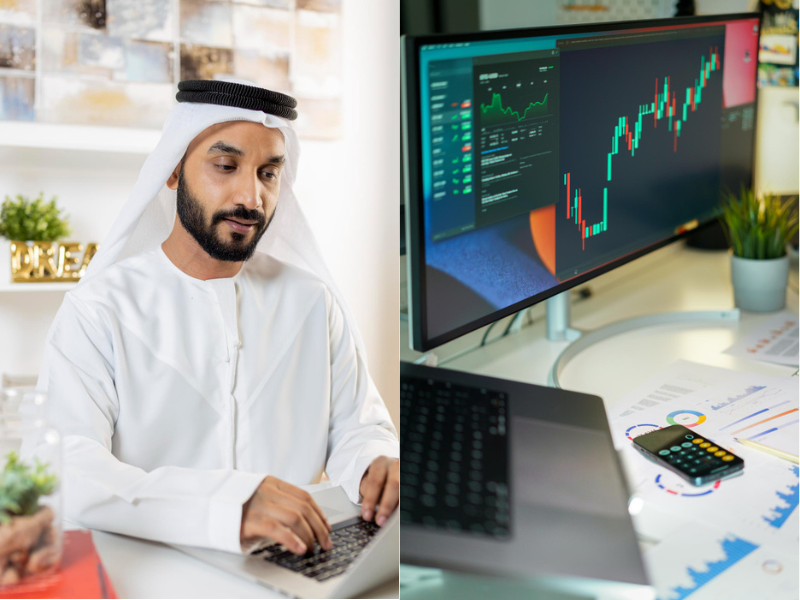
The United Arab Emirates emerged as a federation in 1971 when its economy was largely driven by oil revenues. By the late 1990s, the UAE’s leadership recognised that a diversified financial infrastructure was essential to sustain growth. Driven by the need to diversify, the UAE’s modern stock exchanges were created. The trading activities of these exchanges are monitored by the watchdog, Capital Market Authority (CMA). Beyond routine operations, whenever there are geopolitical tensions, CMA acts swiftly to ensure investor protection and stability of the exchanges.
.
Organised Markets in the Desert Winds
The first formal exchange, the Dubai Financial Market (DFM), was established in March 2000. This was the beginning of organised market in the Desert Winds. It quickly became a cornerstone of Dubai’s strategy to position itself as a regional financial centre. Around the same time, Abu Dhabi launched the Abu Dhabi Securities Exchange (ADX), reflecting the emirate’s own push to institutionalise capital markets. Both exchanges offered companies a structured way to raise funds and gave investors, from local citizens to global institutions, an avenue to participate in the UAE’s growth story.
Expanding the Landscape
The UAE’s exchanges are not limited to DFM and ADX. In 2005, Dubai introduced Nasdaq Dubai (originally the Dubai International Financial Exchange, DIFX), map out as an international platform for equities, derivatives, Sukuk (Islamic bonds), and structured products. Unlike DFM and ADX, which primarily serve domestic investors, Nasdaq Dubai was built to attract global capital, operating under international standards and regulations.
Together, these three exchanges form the backbone of the UAE’s capital market ecosystem:
- DFM – Retail-driven, with strong participation from individual investors.
- ADX – Larger institutional base, reflecting Abu Dhabi’s emphasis on stability and long-term capital.
- Nasdaq Dubai – International orientation, bridging Middle Eastern issuers with global investors.
Role in the Market
The exchanges play multiple roles in the Emirates capital market:
Capital formation: Companies list shares to raise funds for expansion, infrastructure, and innovation.
Wealth distribution: Citizens and expatriates alike can invest.
Transparency and governance: Listing requirements enforce disclosure, improving corporate accountability.
Economic diversification: By channelling investment into sectors beyond oil, exchanges support the UAE’s long-term economic strategy.
Global Ties
Nasdaq Dubai is the clearest symbol of the UAE’s global integration. It operates within the Dubai International Financial Centre (DIFC), under English common law (It is a legal system originated in the medieval England after 1066, based on judicial precedents, customs and court decisions rather than strict, codified statutes), making it attractive to international investors. It has hosted listings from companies across the Middle East, North Africa, and even beyond. Moreover, DFM and ADX maintain cooperative ties with other exchanges, sharing expertise and aligning with international standards to attract foreign capital. Cross-listings and partnerships ensure that UAE markets are not isolated but part of a wider global network.
Trading Volumes and Market Size
As of late February 2026, the market capitalisation (Market Cap is calculated by multiplying the current share price by the total number of outstanding shares: Market Cap = Current Share Price × Total Shares Outstanding) of the Dubai Financial Market PJSC (DFM.AE), which refers to the company that operates the exchange, was approximately AED 12.87 billion ($3.5B – $12.87B depending on source/currency). ADX has grown into one of the largest exchanges in the Arab world. Nasdaq Dubai, though smaller in scale, has carved a niche in Sukuk and derivatives, often hosting landmark issuances that attract international investors.
Trading volumes have fluctuated with global and regional conditions. The boom years of 2004–2005 saw surging activity, while the 2008 financial crisis tested resilience. More recently, reforms and digitalisation have boosted liquidity, with ADX in particular recording sharp increases in daily turnover thanks to institutional participation.
Key DFM listed companies include:
- Financials: Emirates NBD, Dubai Islamic Bank (DIB), Commercial Bank of Dubai (CBD), Ajman Bank, Amlak Finance and Sukoon Takaful.
- Real Estate & Construction: Emaar Properties, Emaar Development, Deyaar Development, Al Mazaya Holding, Arabtec Holding.
- Transportation & Logistics: Air Arabia, Gulf Navigation Holding, Aramex.
- Utilities & Services: Dubai Electricity & Water Authority (DEWA).
.
Safeguards: Circuit Breakers and Controls
Like most modern exchanges, UAE markets also use circuit breakers and other mechanisms to contain unrealistic trading swings. These measures temporarily halt trading if prices move beyond set thresholds, preventing panic-driven collapses or speculative bubbles. Both DFM and ADX have adopted such systems, aligning with international best practices. Nasdaq Dubai, operating under global standards, also enforces similar safeguards.
.
A Narrative of Growth and Ambition
The story of UAE’s stock exchanges is ultimately one of ambition. From humble beginnings in 2000, they have grown into platforms that connect local companies with global capital, empower citizens to invest, and reinforce the UAE’s reputation as a financial hub. They embody the country’s broader narrative: a desert nation transforming itself into a diversified, globally integrated economy.
Looking Ahead
As the UAE positions itself for a beyond‑oil future, its stock exchanges have embraced newer technologies and have carved out a path for future adoption of cutting-edge technologies.
Here is a list of technologies the exchanges have embraced.
- Digital transformation – Blockchain settlement, AI‑driven analytics.
- ESG standards – Sustainability reporting and green finance.
- Fintech integration – Mobile trading apps and cross‑border digital platforms.
.
Three Exchanges in a Nutshell
The UAE has three key exchanges in the capital market ecosystem driving the growth.
Abu Dhabi Securities Exchange (ADX)
Government backed- listings, industry listing. Focus on industries like energy and banking. Headquartered in Abu Dhabi. It was set up in the year 2000 with 12 listed companies and now has 200 listed securities. In 2025, ADX became the first exchange in the region to cross list two US based ETFs on NYSE. ADX Group has set a financial and investment training lab at Liwa University to advance financial education, develop the future industry-ready financial and investment professionals. ADX attaches importance to sustainability initiatives across finance, disclosures and governance, working with all of our stakeholders.
ADXs’ Market Firsts*:
- Cross-listing U.S. ETFs: ADX was the first exchange in the Arab world to introduce cross-listed ETFs (from New York Stock Exchange), representing roughly USD $10 billion in assets.
- Thematic and Digital Offerings: Introduced thematic ETFs with focus on high-growth sectors like quantum computing and Artificial Intelligence.
- ETF Market Expansion: The total number of ETFs listed on ADX expanded considerably, rising to 21.
.
Dubai Financial Market (DMF)
Dubai Financial Market is Islamic-compliant financial exchange based in Dubai. Its main focus is on Real Estate and Financial Services. DMF operates as a public joint-stock company and is a subsidiary of Borse Dubai Limited. The DFM is a primary platform for IPOs and listing for regional and international companies. It continues to be a central hub for capital market activity in the region, supporting both individual and institutional investors.
Nasdaq Dubai
International exchange based at DIFC facilitates regional and international listings.
Highlights**
- Since its inception, Nasdaq Dubai has facilitated listings exceeding US$245 billion in total bonds and Sukuk issuances, of which US$177 billion are Sukuk. Nasdaq Dubai’s Sukuk market has achieved an eightfold increase since 2013. Supported by robust international issuances, outstanding listings have climbed from US$12.6 billion to over US$100 billion.
- Total value of outstanding debt securities listed across DFM and Nasdaq Dubai reached US$150.9 billion in 2025, with Nasdaq Dubai accounting for US$146.1 billion.
Regulator’s role
In the first week of March 2026, The Capital Market Authority, the regulator of the exchanges in the UAE responding to the geopolitical tensions and keeping in mind how fragile investor psychology is, it temporarily suspended trading for two days on March 2 and March 3, 2026. The UAE, with its financial and logistics hub, is especially sensitive to any war like tremors. This swiftness has demonstrated that the capital market in the UAE is mature and intend to move ahead both in good and troubled times.
To sum it up, the story of the UAE’s exchanges transitioning from desert sands to digital screens, it is a story of ambition. Today, the exchanges stand as pillars of a diversified economy, connecting local investors to global capital flows. Their journey is not just financial—it is cultural, symbolic, and deeply tied to the UAE’s identity as a nation that thrives on reinvention.
*ADX- 2025 in Review
** Source: Nasdaq Dubai
Blog by Imtiaz Ahmed Shariff