
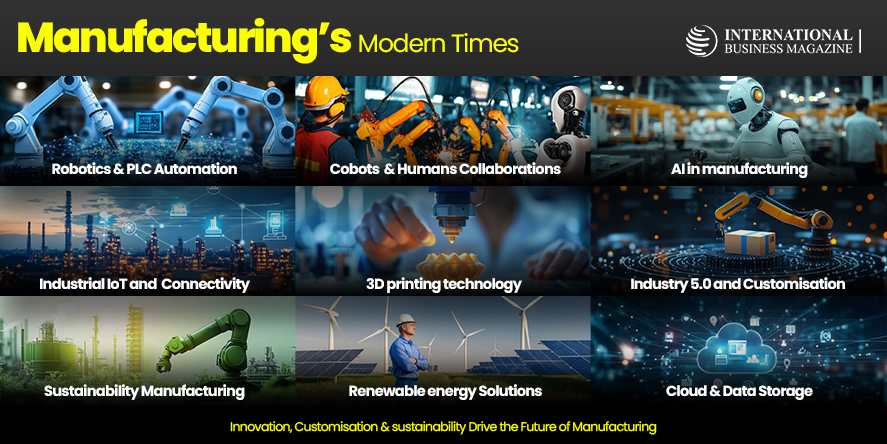
Industrial automation, particularly in manufacturing sector, dates back to 18th Century. The “First” Industrial Revolution was the beginning of the adoption of new technologies described as Industry 1.0. Today Industry 5.0 with emphasis on human edge and strengthening collaboration between humans and robots is emerging. Currently, Industry 4.0 is driving the digital transformation of modern manufacturing. This indicates the adoption of cutting-edge technology is powering traditional factories to migrate into interconnected, data-driven smart environments. The process of manufacturing has moved from Stone tools to AI-enabled Robotics.
When we consider the trajectory of modernisation, we are often reminded of the profound anxieties surrounding automation, most famously captured in Charlie Chaplin’s Modern Times (1936). Through masterful satire, Chaplin transforms the factory floor into a mechanised labyrinth where workers are reduced to mere cogs in the machinery.
Since 18th Century, the manufacturing industry has always been a mirror of human progress, reflecting the tools, techniques, and technologies that define each era since the time economic historian Arnold Toynbee coined the word “Industrial Revolution”. From the clanging of steam-powered machines in the Industrial Revolution to the quiet hum of robotic arms in today’s smart factories, the sector has consistently embraced innovation as its lifeblood.
In recent decades, the pace of technological adoption has accelerated; reshaping manufacturing into a domain where precision, efficiency, and adaptability are realities. The integration of advanced technologies has transformed production floors into ecosystems of intelligence, where machines communicate, data drives decisions, and human ingenuity finds new avenues of expression.
Minimal Human Intervention
In the Industry 4.0 era, to take manufacturing activity to the next level, automation remains the cornerstone of this transformation. Early mechanisation replaced manual labour with machines, but modern automation has gone far beyond repetitive tasks. Programmable Logic Controllers (PLC), Robotics, and Computer-integrated manufacturing systems now take centre stage in the complex processes of manufacturing with minimal human intervention. Today, Robots weld, assemble, and package with speed and accuracy, while collaborative robots – cobots – work alongside humans, enhancing productivity without replacing the human touch.
Digitisation & the Rise of IIoT
Digitalisation has added another layer of sophistication in manufacturing process. The rise of the Industrial Internet of Things (IIoT) has connected machines, sensors, and systems into networks that constantly exchange information. Every movement of a robotic arm, every vibration in a motor, every fluctuation in temperature is captured, analysed, and acted up on. Predictive maintenance, powered by data analytics, ensures that machines are serviced before breakdowns occur, reducing downtime and saving costs. Smart factories, often described as the beating heart of Industry 4.0, thrive on this connectivity, where real-time insights guide production schedules, resource allocation, and supply chain management.
AI walks the talk
Artificial Intelligence has become the brain behind manufacturing operations in the transitional Industry 5.0 era. Algorithms play a vital role by sifting through reams of data to identify patterns often missed by human eyes. AI-driven systems optimise workflows, forecast demand, and even design new products by simulating variations before a prototype is developed. In quality control, machine vision systems detect defects at microscopic levels, ensuring that only flawless products reach the end consumers. The role of AI also extends into other areas such as logistics, procurement, and customer engagement, creating a seamless chain from raw material to finished product.
Advent of 3D printing
Industry 4.0 and the emerging Industry 5.0 is witnessing the emergence of Additive manufacturing, or 3D printing. This paradigm shift in how the products are designed and produced has revolutionised the manufacturing process. Manufacturers can now build complex geometries layer-by-layer, reducing waste and enabling customisation at scale. For example, aerospace companies print lightweight components, medical firms produce patient-specific implants, and automotive manufacturers experiment with rapid prototyping – all testaments to how this technology has expanded the boundaries of possibility in manufacturing process.
Sustainability, a driving force
Today, industry is giving prominence to sustainability. Manufacturers see through the prism of sustainability to scale up production and financial and environmental benefits from sustainable business practices. Sustainability in the emerging Industry 5.0 has become a driving force in technological adoption. Energy-efficient machinery, renewable energy integration, and waste-reduction technologies are now central to manufacturing strategies. Smart grids and energy management systems monitor consumption, while circular economy principles enabling recycling and reuse.
The Role Cloud Platforms
Cloud computing and digital twins in modern times have further revolutionised the manufacturing landscape. Cloud platforms allow manufacturers to store, process, and share data across geographies, enabling collaboration and agility. Digital twins – virtual replicas of physical assets – simulate performance under varying conditions, allowing engineers to test scenarios without disrupting actual production. This blend of virtual and physical realms has opened new dimensions in design, troubleshooting, and innovation.
In this era of Industrial Revolution, human roles have also evolved in tandem with these technologies. Workers are now required to upgrade their skills and acquire digital literacy, analytical skills, and adaptability. Manufacturers are using training programmes that emphasise human-machine collaboration, prepare employees to oversee automated systems, interpret data, and make strategic decisions. Technology has elevated their role from operators to intelligent workers guiding machines with insight and creativity and not as cogs in the machine as feared by Charlie Chaplin in Modern Times. The adoption of the latest technology has also reshaped global supply chains. Advanced tracking systems, blockchain-based ledgers, and AI-driven logistics ensure transparency, efficiency, and resilience. Manufacturers can trace materials from origin to destination, anticipate disruptions, and respond with agility.
Looking ahead, the manufacturing industry’s embrace of newer technologies of the emerging Industry 5.0 such as quantum computing advanced robotics, and bio-manufacturing, collaborative robotics, applied AI, sustainability, Quantum algorithms, and human-centric design may further revolutionise manufacturing. The trajectory is clear: manufacturing will continue to be the crucible where the latest technologies are tested, refined, and scaled, shaping not only products but also the very aspect of modern life.
Conclusion
The factory of today is no longer a place of noise and repetition but a realm of intelligence and innovation. In a world where geopolitical shifts and pandemics disrupt trade overnight, technology has become the shield that protects continuity in all aspects of human activity.
Article by Imtiaz Ahmed Sharif