
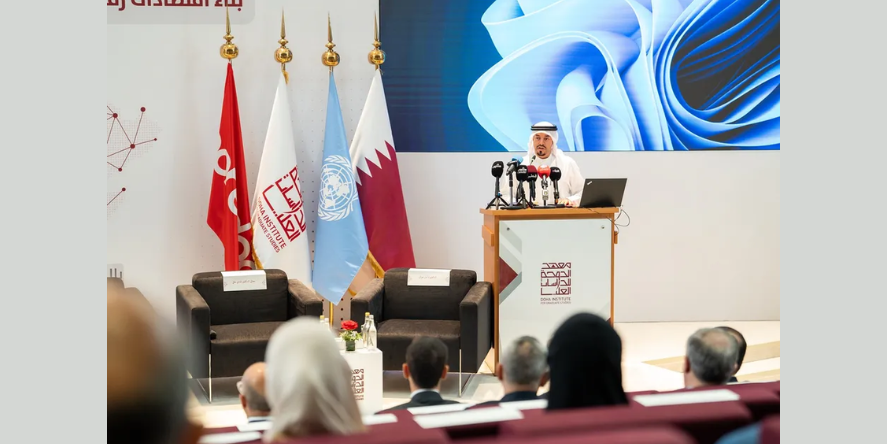
Ooredoo Group and the United Nations Development Programme (UNDP), in partnership with the Doha Institute for Graduate Studies and in cooperation with GSMA and Women in AI, recently opened the High-Level Digital & AI Policy Leaders Forum – Arab States Region in Doha, bringing together senior government officials, regulators, international organisations, technology and telecommunications leaders, academia and development partners to advance more inclusive and sustainable digital economies across the Arab region.
The Forum opened with a high-level plenary attended by H.E. Mohammed bin Ali Al Mannai, Minister of Communications and Information Technology, with opening remarks from Dr. Abdelwahab El-Affendi, President of the Doha Institute for Graduate Studies; Biplove Chaudhary, UNDP Technical Representative and Head of the UNDP Qatar Office; and Hilal Mohammed Al-Khulaifi, Ooredoo Group Chief Legal and Regulatory Officer.
The ministerial discussion brought together H.E. Dr. Abdel Razzaq Natsheh, Minister of Telecommunications and Digital Economy, State of Palestine; H.E. Dr. Fadi Makki, Minister of State for Administrative Reform, Lebanese Republic; H.E. Ziad Abdelwaret Elhajjaji, Minister of State for Digital Economy and AI, Libya; and H.E. Dr. Yousif Khalaf, Chairman of the Prime Minister’s Advisory Commission, Iraq. They were joined by Jawad Abbassi, Regional Director MENA, GSMA, and Elina Silen, Regional Programme Manager, UNDP.
Taking place on 1–2 September, the Forum marks the next phase of the Digital Policy Framework (DPF) for the Arab States, launched by UNDP, Qatar’s Ministry of Communications and Information Technology and Ooredoo Group at MWC Doha in November 2025. The evidence-based framework was developed to support governments in designing digital policies that promote inclusion, economic growth and human development.
Hilal Mohammed Al-Khulaifi, Group Chief Legal and Regulatory Officer, Ooredoo, said: “Digital transformation can create enormous economic and social value for our region, but technology alone is not enough. It requires the right policies, regulatory environment and collaboration between the public and private sectors. The priority now is to move from framework to implementation understanding where individual markets stand, what needs to change and how we turn policy into tangible progress.”
The DPF focuses on three interconnected areas critical to building competitive digital economies: networks and connectivity; data and digital public infrastructure; and intelligent systems and applications, including the responsible use of AI across sectors such as health, education, agriculture and public services.
Biplove Chaudhary, UNDP Technical Representative and Head of the UNDP Qatar Office, said: “Digital transformation delivers its greatest impact when connectivity, digital public infrastructure and emerging technologies advance together within an inclusive policy environment. The Digital Policy Framework helps countries identify gaps and prioritise action according to their national contexts. This Forum takes the next step, translating regional ambition into practical country-level implementation, while benefiting from Qatar’s leadership in innovation and digital infrastructure.”

Over the two days, participating countries will learn how to assess their digital maturity using the Digital Policy Framework, identify priority reforms and begin the journey of developing national Digital Policy Roadmaps. Discussions will address connectivity, digital public infrastructure, data governance, financial inclusion, and AI deployment and governance, alongside peer exchange and regional case studies.
Dr. Abdelwahab El-Affendi, President of the Doha Institute for Graduate Studies, said: “This Forum brings knowledge and practice together to address one of our region’s defining challenges: harnessing digital technology to strengthen economies, advance human progress and serve society. Success requires balanced governance that enables innovation while managing risk, particularly as AI creates unprecedented opportunities. Through serious collaboration across government, industry and academia, we can turn these opportunities into meaningful, responsible progress.”
The economic stakes are significant. Evidence referenced in the DPF indicates that a 10% increase in fixed broadband penetration can increase GDP by up to 1.5% in developing countries, while AI could contribute an estimated USD 21–35 billion annually to GCC GDP when deployed through inclusive and accountable policy frameworks.
The Forum will conclude on 2 September with discussions on the proposed Regional Digital Policy Facility, designed to support countries in implementing the DPF through shared tools, benchmarking, technical assistance and peer learning.