

Financial Analytics in Subscription Models
Financial analytics has become one of the most critical foundations of decision-making in subscription-based businesses. As SaaS platforms, fintech services, AI products, and digital subscriptions continue to scale globally, companies are no longer competing only on product innovation or customer acquisition, but on how effectively they understand and interpret their financial data. In this environment, financial analytics is no longer a reporting function; it has become a strategic system that directly shapes business direction, risk management, and long-term sustainability.
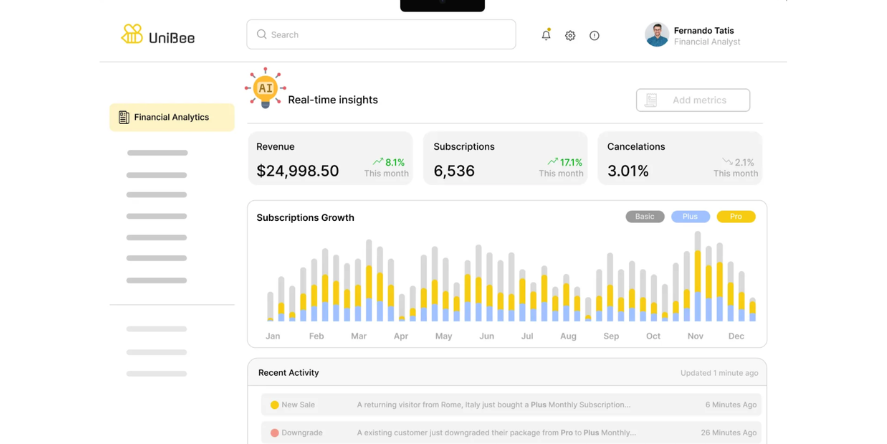
Modern platforms are increasingly embedding advanced analytics directly into their operational infrastructure. Solutions such as UniBee with its financial analytics ecosystem reflect this shift by integrating structured financial intelligence into subscription operations, allowing businesses to analyze revenue performance, behavioral patterns, and operational data through a unified analytical layer. Rather than treating analytics as a separate reporting tool, these systems position financial data as a core decision engine that supports forecasting, optimization, and strategic planning.
The evolution of financial analytics reflects a broader change in how businesses operate. Traditional financial reporting was built around static documents, historical summaries, and retrospective evaluations. Monthly revenue reports, quarterly performance statements, and annual financial reviews were designed primarily for compliance and record-keeping rather than strategic intelligence. This model no longer fits subscription economies, where revenue is continuous, customer relationships are long-term, and financial performance depends on dynamic user behavior rather than one-time transactions.
Control is The New Currency in Financial Analytics
Subscription-based business models operate on fundamentally different logic. Revenue is distributed across time, customer value compounds gradually, and growth depends on retention as much as acquisition. In this context, financial analytics must go beyond simple revenue tracking. It must capture patterns, predict outcomes, and provide visibility into future performance, not just past results. This transformation has turned financial analytics into a forward-looking intelligence system rather than a backward-looking reporting process.
As subscription ecosystems become more complex, the demand for control over financial data has increased. Many legacy analytics systems rely on fixed assumptions, standardized dashboards, and rigid calculation models. These structures may work for simple billing environments, but they quickly become limitations when businesses operate across multiple markets, currencies, tax jurisdictions, pricing models, and subscription tiers. Generic analytics frameworks struggle to reflect real business complexity.
This has led to a growing emphasis on granular control within financial analytics systems. Granular control means that organizations can define how their financial data is structured, calculated, interpreted, and visualized based on their own business logic rather than external system limitations. Instead of adapting business models to fit software constraints, modern analytics systems adapt to business realities.
This shift transforms financial analytics into an operational intelligence layer that influences every part of the organization. Finance teams use it for forecasting and compliance, product teams use it for pricing strategy and feature investment, marketing teams use it for customer lifetime value modeling, and leadership teams use it for strategic planning. Financial analytics becomes a shared intelligence framework rather than a siloed function.
One of the most important changes in modern analytics is the move from standardization to configurability. Configurable financial analytics allows businesses to define how revenue is categorized, how taxes are calculated, how metrics are structured, and how dashboards are organized. This configurability enables companies to reflect real operational complexity in their data models rather than forcing simplifications that distort insight quality.
Precision has also become a defining requirement of modern financial analytics. Small inaccuracies in recurring revenue models scale rapidly over time. Minor errors in churn modeling, revenue attribution, tax calculation, or forecasting assumptions can compound into major strategic misalignments. Precision-driven analytics allows organizations to build reliable forecasts, accurate growth models, and stable financial planning structures.
Financial analytics is increasingly being used as a growth engine rather than a support function. By embedding analytics into operational systems, businesses create continuous feedback loops between data and decision-making. This allows organizations to optimize pricing structures, refine subscription models, improve retention strategies, and allocate resources more effectively. Analytics becomes a driver of performance rather than a reflection of it.
In subscription environments, the richness of available data creates new opportunities for deeper intelligence. Financial data can now be connected with behavioral data, usage data, and engagement metrics to produce integrated insights. This allows businesses to understand not only how much revenue they generate, but why they generate it, where it is sustained, and where it is at risk.
Granular Financial Analytics
Granular financial analytics enables organizations to analyze revenue performance at multiple levels, including plan structures, customer segments, regions, and usage patterns. This creates a multidimensional understanding of business health rather than a single aggregated view. It allows leaders to identify which revenue streams are stable, which are volatile, and which offer long-term growth potential.
Advanced tax modeling also plays a critical role in financial analytics accuracy. Tax structures directly impact net revenue, margin analysis, regional performance measurement, and forecasting reliability. Configurable tax calculation frameworks allow businesses to model financial performance realistically across jurisdictions, ensuring that analytics reflects economic reality rather than accounting simplifications.
Tailored analytics dashboards further strengthen decision-making by allowing organizations to define what matters to their specific business model. Instead of relying on generic KPI templates, companies can design analytics environments that reflect their operational priorities, revenue structures, and strategic objectives. This personalization transforms dashboards into strategic tools rather than passive visualizations.
Plan-level financial analytics provides additional strategic value by allowing businesses to understand how different subscription tiers perform over time. This supports smarter pricing strategies, more effective product design, and better revenue sustainability planning. By analyzing performance at the plan level, organizations gain insight into profitability, retention, and long-term value creation.
Financial analytics also plays a central role in business model adaptability. As markets evolve and customer expectations change, businesses must continuously experiment with pricing, packaging, and revenue structures. Adaptable analytics systems allow organizations to test new models, measure outcomes, and refine strategies without disrupting operational stability. This flexibility supports innovation while maintaining financial discipline.
Over time, financial analytics becomes a source of long-term competitive advantage. Organizations that build mature analytics systems develop stronger forecasting capabilities, better risk management structures, and more resilient growth models. Data-driven decision-making becomes embedded into organizational culture, creating learning systems that continuously improve performance.
Conclusion
In modern subscription economies, financial analytics is no longer an auxiliary system. It is the core infrastructure. It shapes how businesses grow, how they scale, how they manage risk, and how they sustain revenue. Granular control, configurability, and precision are no longer advanced features; they are foundational requirements.
As subscription models continue to expand across industries, financial analytics will increasingly define which companies succeed in building sustainable, scalable, and resilient business systems. The future of subscription growth will belong not to those who collect the most data, but to those who structure, control, and interpret it with intelligence and precision.
Blog Received on Mail