
The United Arab Emirates (UAE) has emerged as one of the most dynamic financial centres in the Middle East, with local banks playing a pivotal role in shaping its economic trajectory. These institutions are more than just custodians of deposits; they are engines of growth, resilience, and innovation. By empowering businesses, expanding access to financial services, and accelerating digital innovation, local banks in the UAE contribute significantly to the growth of the economy and further solidify their status as a leading centre for trade and investment.
Within the Middle Eastern region, the United Arab Emirates is the leading banking sector.

The Backbone of Financial Services
As a backbone of financial services, local banks in the UAE provide essential services to individual customers, corporations, and government entities. From savings accounts and personal loans to corporate financing and trade facilitation, they ensure that capital flows smoothly through the economy. Their ability to channel deposits into productive investments sustains liquidity and supports long‑term development.
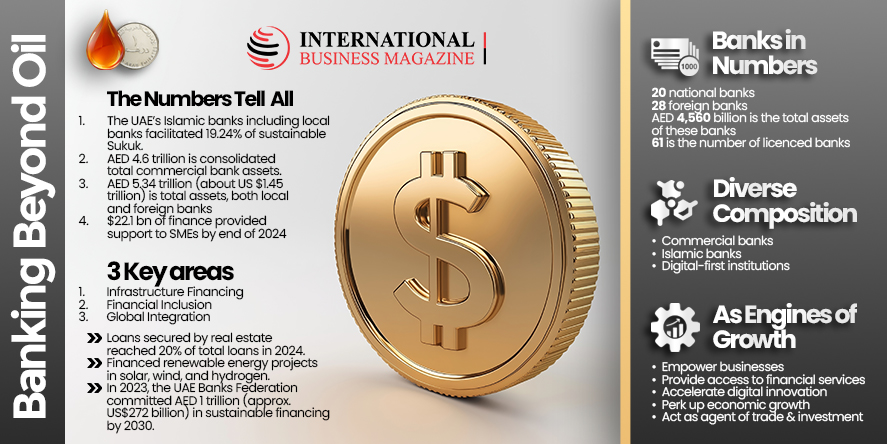
A notable feature of the UAE banking sector is its diverse composition, which includes commercial banks, Islamic banks, and an increasing number of digital-first institutions. This diversity ensures that the needs of different segments—citizens, expatriates, small businesses, and multinational corporations—are met effectively. Local banks are deeply embedded in the country’s economic fabric, making them indispensable to its stability and growth.
Supporting Small and Medium Enterprises (SMEs)
Small and Medium Enterprises (SMEs) are considered the lifeblood of the UAE economy, contributing significantly to GDP and employment. Local banks have been instrumental in nurturing this sector by offering tailored loan programmes, advisory services, and flexible financing solutions. By enabling entrepreneurs to access capital, banks empower innovation and job creation which in turn contributes to the health of the economy that is facing headwinds across the globe due to geopolitical tensions and tariff barriers.
This support aligns with the UAE’s national vision of diversifying its economy beyond oil. As the country invests in sectors such as technology, renewable energy, and tourism, local banks provide the financial scaffolding that allows SMEs to thrive. Their role in SME development is not just about lending—it is about building confidence and fostering a culture of entrepreneurship, which in turn strengthens the UAE economy. The local Banks provided $22.1bn in financial facilities to SMEs by the end of H1 of 2024, according to the Central Bank of the UAE (CBUAE).
Driving Digital Innovation
As the world is fast embracing digitalisation, and the UAE too is at the forefront of digital transformation, and local banks are leading the charge. They are investing heavily in Fintech partnerships, mobile banking apps, Artificial Intelligence, and Blockchain solutions. These innovations enhance efficiency, reduce costs, and expand access to underserved populations which are an integral part of a country’s economic growth.
The UAE’s digital banking services by local banks has become a cornerstone of customer convenience. From instant transfers to biometric authentication, local banks are redefining the way how people interact with financial institutions. Importantly, this digital push is not only about technology—it is about inclusion. The banks also extended services to remote areas and expatriate communities.
Capitalisation and Profitability
Local banks are well‑capitalised and profitable so that they remain resilient to external shocks. Their strong liquidity ratios safeguard the economy during periods of uncertainty. This financial strength allows them to continue lending and investing even amid global market turbulence. The overall state of the UAE local bank liquidity is robust.
Islamic Banking
Islamic banks add another layer of diversity to the financial system in UAE banking sector. By offering Sharia‑compliant products, local banks attract investors seeking ethical finance options. This segment has grown steadily, contributing to financial stability and broadening the appeal of the UAE as a global financial hub which in turn boosts the country’s economic growth. The UAE’s Islamic banks including local banks have facilitated 19.24% of sustainable Sukuk (Sharia-compliant investment certificates) issuances globally, strengthening the UAE’s position as a leading hub for Islamic sustainable finance.

.
Local Banks and National Development
Local banks in the UAE play a vital role in national development infrastructure finance to global integration.
i) Infrastructure Financing
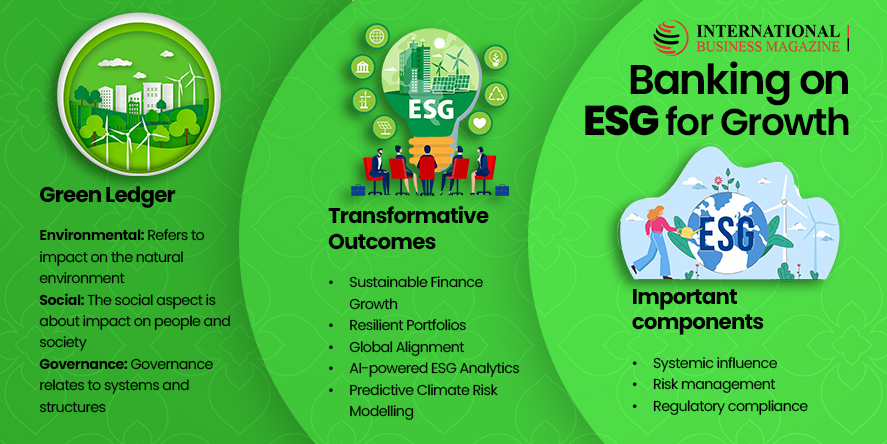
Local banks finance mega projects in real estate, transport, and energy. Their involvement in initiatives such as Expo 2020 and renewable energy projects demonstrates their commitment to national development. By funding infrastructure, banks help build the physical backbone of the UAE’s future economy. As of 2024–2025, UAE local banks have maintained robust lending activity, with significant, yet moderated, exposure to the real estate sector. Total banking sector loans secured by real estate reached approximately 20% of total loans in 2024. In the energy sector, UAE banks are actively financing renewable energy projects, including solar, wind, and hydrogen energy, to align with climate goals. In 2023, the UAE Banks Federation has committed to providing AED 1 trillion (approx. US$272 billion) in sustainable financing by 2030. The pledge was made during Finance Day at the COP28 climate summit in Dubai.
ii) Financial Inclusion
Local banks have expanded their branch networks and digital platforms to ensure that both citizens and expatriates have access to financial services. This inclusiveness fosters consumer spending and investment, strengthening domestic demand. Financial inclusion goes beyond mere access: it is about empowering people to engage fully in economic activities, and local banks are leading the way in making this positive impact possible.
iii) Global Integration
The UAE local banks facilitate international trade and remittances. Their role in foreign exchange and cross‑border financing connects the country to global markets. By supporting trade flows and expatriate remittances, banks reinforce the UAE’s position as a global financial hub aiding the nation’s economic strength. The size of UAE banking sector in consolidated total commercial bank assets stands at AED 4.6 trillion. The combined customer base of top local institutions is massive.
According to the Central Bank of the UAE (CBUAE) the total assets held by UAE banks, which includes both local and foreign banks, reached approximately AED 5.34 trillion (about US $1.45 trillion) as of the end of December 2025. Overall, local banks in the UAE are more than financial intermediaries—they are strategic partners in national development. By financing SMEs, investing in digital innovation, and supporting infrastructure projects, they reinforce the UAE’s economic resilience. As the UAE continues to evolve economically, local banks will remain at the heart of its journey. Their role in strengthening the economy is not just about numbers—it is about building trust, enabling opportunity, and shaping a future where prosperity is shared across society.
The UAE currently has 20 local (national) banks, alongside 28 foreign banks operating in the country. The total assets of the UAE banking sector increased by 12.0% Y-o-Y to AED 4,560 billion by the end of 2024. The number of licensed banks in the UAE remained at 61, comprising 23 UAE national banks and 38 branches of foreign banks operating in the UAE, according to CBUAE.
Major Banks in UAE
Major local banks in the UAE include First Abu Dhabi Bank (FAB), Emirates NBD, Abu Dhabi Commercial Bank (ADCB), Dubai Islamic Bank (DIB), and Mashreq Bank. Other prominent, locally headquartered institutions include RAKBANK, Abu Dhabi Islamic Bank (ADIB), Commercial Bank of Dubai (CBD), Sharjah Islamic Bank (SIB), and Ajman Bank.
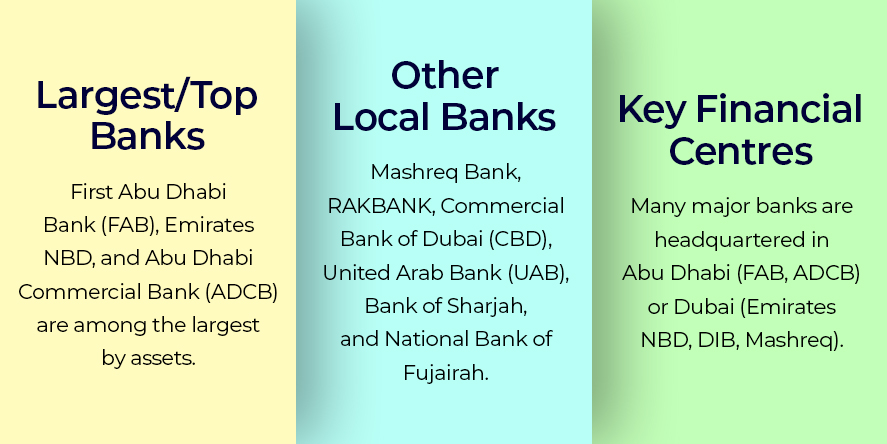
- Largest/Top Banks: First Abu Dhabi Bank (FAB), Emirates NBD, and Abu Dhabi Commercial Bank (ADCB) are among the largest by assets.
- Other Local Banks: Mashreq Bank, RAKBANK, Commercial Bank of Dubai (CBD), United Arab Bank (UAB), Bank of Sharjah, and National Bank of Fujairah.
- Key Financial Centres: Many major banks are headquartered in Abu Dhabi (FAB, ADCB) or Dubai (Emirates NBD, DIB, Mashreq).
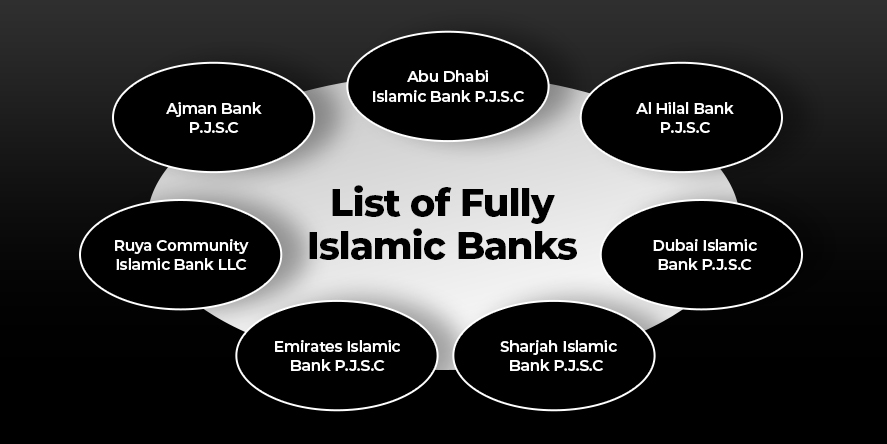
List of Fully Islamic Banks:
- Abu Dhabi Islamic Bank P.J.S.C (Local)
- Al Hilal Bank P.J.S.C (Local)
- Dubai Islamic Bank P.J.S.C (Local)
- Emirates Islamic Bank P.J.S.C (Local)
- Ruya Community Islamic Bank LLC (Local)
- Ajman Bank P.J.S.C (Local)
- BOK International Bank (Foreign)
- El Nilein Bank (Foreign)
- Sharjah Islamic Bank P.J.S.C (Local)
List of Banks with Islamic Windows:
- Abu Dhabi Commercial Bank P.J.S.C (Local)
- Commercial Bank International PLC (Local)
- Emirates NBD Bank P.J.S.C (Local)
- Habib Bank A.G Zurich (Foreign)
- Mashreq Bank P.S.C. (Local)
- National Bank of R.A.K P.J.S.C (Local)
- Samba Financial Group (Foreign)
- United Arab Bank P.J.S.C (Local)
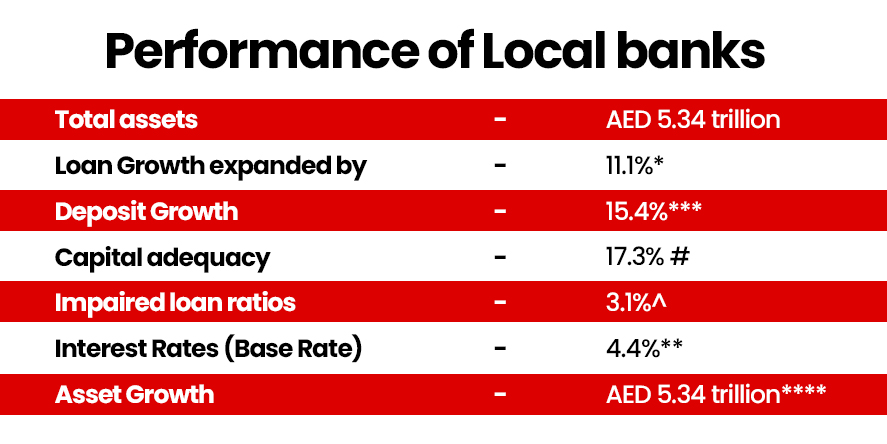
* Y-o-Y in Q2 2025, *** Y/Y (Q3), # in Q2 2025. ^by Q3 2025, ** in July 2025, **** by Dec 2025
Article by Imtiaz Ahmed Shariff.