
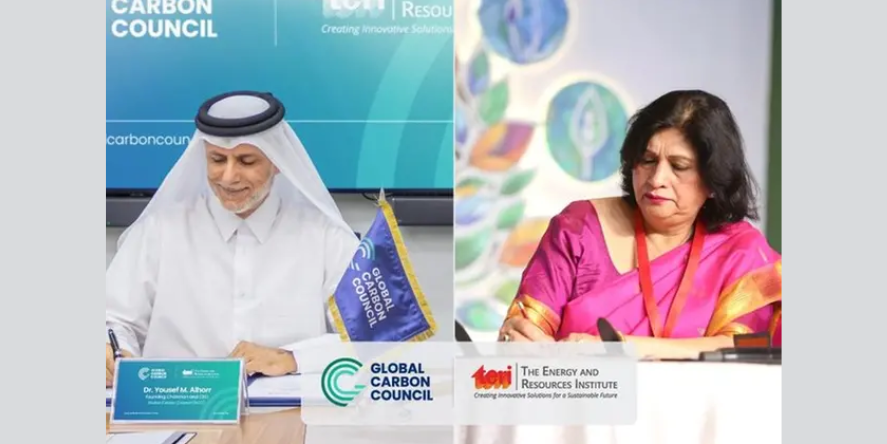
Global Carbon Council (GCC), one of the first internationally accredited carbon standard in the Global South, and The Energy and Resources Institute (TERI), India’s leading not-for-profit research organization dedicated to sustainable development, have signed a landmark Memorandum of Understanding (MoU) to establish India’s one of the first digital carbon marketplaces for household and livelihood-based clean energy projects under TERI’s flagship LaBL 2.0 – Lighting a Billion Livelihoods.
The MoU was formalized by Dr. Yousef Alhorr, Founding Chairman of GCC, and Dr. Vibha Dhawan, Director General of TERI, marking a strategic partnership aimed at unlocking carbon finance for Distributed Renewable Energy (DRE) solutions such as solar lighting, clean cooking technologies, and productive-use appliances in rural and underserved communities across India for livelihood purposes.
This collaboration will provide a new pathway for community-scale projects to participate in high-integrity international carbon markets by transforming small-scale, household-level climate action into measurable, verified, and tradable carbon credits and avail carbon finance for projects benefiting poor communities.
Addressing India’s Clean Energy and Livelihood Challenge
Despite India achieving a major milestone in 2025, sourcing more than 50% of its installed electricity capacity from non-fossil fuels and reaching its Paris Agreement clean energy target five years ahead of schedule, over 250 million people in India still lack access to clean and reliable energy solutions. Decentralized renewable energy has emerged as a critical pillar of the country’s energy transition, enabling both climate mitigation and socio-economic development.
By linking LaBL 2.0 projects with GCC’s global carbon market infrastructure, the partnership will enable small household and livelihood interventions to generate internationally recognized carbon credits, turning everyday clean energy actions into climate assets while strengthening the financial sustainability of rural and community-based energy projects.
Building a Digital Carbon Marketplace for Communities
Under the MoU, GCC and TERI will jointly explore the development of a fully digital Energy Access and Carbon Marketplace or integrate LaBL 2.0 projects into GCC’s World Bank-supported ASCENT Energy Access Portal.
The platform will allow the aggregation of household and small-business projects to generate carbon credits through robust Digital MRV (Monitoring, Reporting, and Verification) systems lowering transaction costs and ensuring high efficiency, transparency, traceability, and environmental integrity from registration to credit issuance and retirement.
The initiative includes structured engagement with key Indian government institutions to explore potential recognition of LaBL 2.0 carbon credits under compliance carbon markets e.g. Article 6.2.
National Implementation and Capacity Building
TERI will serve as the national focal point for the Energy Access Program in India under LaBL 2.0. GCC and TERI, tasked with specific responsibilities, shall jointly operate the program and conduct capacity-building activities for participating households and micro-enterprises. These capacity-building initiatives will equip communities with the knowledge, skills, and tools required to implement projects, participate in carbon markets, and ensure the long-term sustainability of clean energy and livelihood interventions.
Dr. Yousef Alhorr, Founding Chairman of the Global Carbon Council, said, “Our partnership with TERI represents a decisive step toward making carbon markets work for people at the grassroots level. By combining the Global Carbon Council’s digital Carbon Market Infrastructure (CMI) and ASCENT Energy Access Program Portal with TERI’s deep expertise in energy access and livelihoods, we are creating a scalable model that transforms household clean energy actions into verified climate assets. This initiative aims to establish how digital and efficient carbon markets drive economic growth at lowerstrata of society while maintaining the highest standards of environmental integrity.”
Dr. Vibha Dhawan, Director General of TERI, added, “LaBL 2.0 reflects TERI’s commitment to move beyond energy access toward energy-enabled livelihoods. Through the collaboration with GCC, we aim to channel carbon finance into women-led enterprises, rural micro-industries, and community infrastructure, ensuring that climate action translates into tangible social and economic benefits. This partnership will help position India as a global leader in people-centered carbon market innovation.”
Technology with Integrity and Impact
The initiative will be underpinned by GCC’s digital ASCENT Energy Access Program Portal and Carbon Market Infrastructure (CMI), ensuring transparent accounting from project registration through issuance, transfer, and retirement of carbon credits. This framework prevents double-counting and safeguards both environmental and social integrity.
By integrating decentralized clean energy with carbon finance, the program is expected to:
- Improve the financial viability of rural energy projects.
- Create new income streams for households and micro-enterprises.
- Support women-led livelihood initiatives.
- Strengthen India’s contribution to global climate mitigation efforts.
A Blueprint for the Global South
Beyond India, the GCC-TERI collaboration is designed as a replicable model for other developing countries seeking to connect household-scale climate action with international carbon markets through digital systems and high-integrity standards. As countries increasingly look for solutions that unite climate mitigation with development priorities, this partnership sets a new benchmark for how carbon markets can serve communities and not just corporations.