
In the shimmering skylines of Dubai and Abu Dhabi, where glass towers rise beside traditional souks, the mortgage sector has quietly become one of the most important engines of the UAE’s real estate story. Once dominated by cash buyers and institutional investors, the market is now seeing a steady increase by participation of individual nationals, expatriates, and even non‑residents. They are turning to mortgages as their gateway to property ownership in the kingdom.
The Big Picture
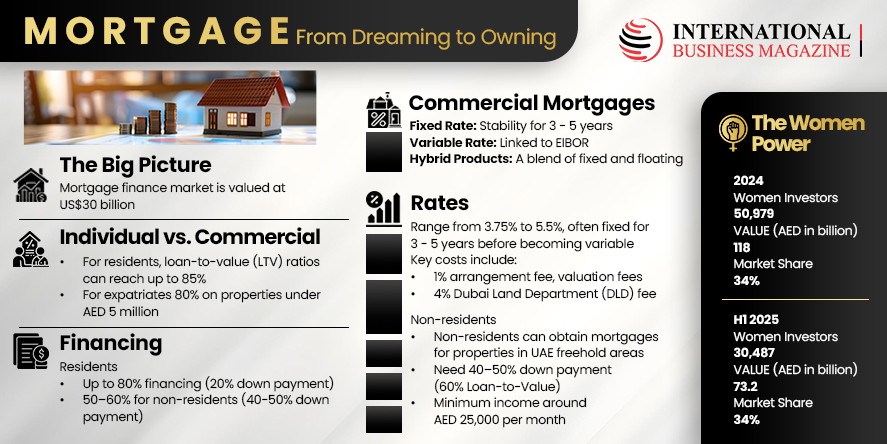
The UAE mortgage sector has matured significantly over the past decade. With the Central Bank’s (CBUAE) base rate (Base Rate is the benchmark for overnight market interest rates) currently at 3.65%. The CBUAE typically follows the US Federal Reserve’s interest rate decisions as the UAE dirham is pegged to the US Greenback. The current rate was fixed following a 25-basis-point cut in December 2025. The mortgage products have diversified to cater to both individuals and businesses. Yet, compared to global benchmarks, mortgage penetration remains modest. Many buyers still prefer cash transactions, reflecting the region’s high liquidity and cultural preference for debt‑free ownership.
.
Pointers to the CBUAE’s 3.65% Base Rate
Maintenance: The CBUAE kept the rate at 3.65% at the end of January 2026, in line with the U.S. Federal Reserve’s stance.
Borrowing Rate: The interest rate for borrowing short-term liquidity from the CBUAE remains 50 basis points above the base rate.
Context: This follows a 25-basis point cut in December 2025, which lowered the rate to the current 3.65%.
Monetary Policy: The base rate is anchored to the U.S. Federal Reserve’s Interest Rate on Reserve Balances (IORB).
The UAE’s mortgage finance market is valued at US$30 billion. This growth is driven by a robust real estate market, an increasing expatriate population, and favourable government policies. Dubai and Abu Dhabi remain key cities in this segment. While Dubai’s position as a global business hub drives high demand for residential properties, Abu Dhabi, as the capital, benefits from massive government investments and infrastructure projects. In 2023, the UAE government implemented a new regulation aimed at bringing more transparency in mortgage lending. This regulation requires that all mortgage providers disclose full information regarding interest rates, fees, and terms to potential borrowers.
.

Individual vs. Commercial Mortgages
Individual Mortgages: For residents, loan‑to‑value (LTV) ratios can reach up to 85% for nationals and 80% for expatriates on properties under AED 5 million. First‑time buyers are increasingly active, encouraged by flexible repayment options and competitive rates.
Commercial Mortgages: Businesses can access financing through fixed, variable, or hybrid structures.
• Fixed Rate: Stability for 3–5 years, shielding borrowers from market swings.
• Variable Rate: Linked to EIBOR (Emirates Interbank Offered Rate), offering flexibility but exposing borrowers to fluctuations.
• Hybrid Products: A blend of fixed and floating, allowing companies to lock in certainty before moving to market‑linked terms.
.
Market Dynamics & Buyer Behaviour
The UAE’s property market is designed by a mosaic of local and global factors:
- Nationals: Tend to buy for long‑term ownership, often leveraging mortgages for family homes.
- Expatriates: Increasingly view mortgages as a viable path to investment, especially with residency visas tagged to property ownership.
- First‑Time Buyers: Motivated by lower entry barriers, affordability in prime districts remains a challenge.
- The golden shift: Golden Visa policies and international investor interest have further boosted demand. Younger buyers are more open to financing compared to older generations who prefer cash.
.
Regulatory Framework
The Central Bank of the UAE enforces strict rules to ensure stability:
- Debt‑to‑Income Limits: Borrowers cannot exceed 50% of monthly income obligations.
- Loan‑to‑Value Caps: Protect lenders and borrowers from over‑leveraging.
- Transparency Mandates: Banks must disclose all fees and terms clearly.
- Non‑Residents can avail mortgages, though typically capped at 60–70% of property value.
- Income verification and property type restrictions apply, but the door is open—especially for investors eyeing Dubai’s luxury market.
.
Institutions offering Mortgages
Major Banks
Typical Rates: Fixed rates around 3.99%–4.19% for 1–5 years, often requiring salary transfer.
Loan-to-Value (LTV): Up to 80% for expats (properties AED million), 85% for nationals, and 60-65% for non-residents. Loan to value is the term used by banks when lending against an asset. The percentage denotes how much a bank is willing to lend against the value of the asset.
.
The Big 8
1. Emirates NBD
2. First Abu Dhabi Bank (FAB)
3. Abu Dhabi Commercial Bank (ADCB)
4. Mashreq Bank
5. Dubai Islamic Bank
6. Emirates Islamic
7. HSBC Middle East
8. Standard Chartered UAE
.
Non‑Banking Institutions
• Mortgage Finder
• Bayut Mortgage Services
• Independent mortgage consultancies and brokers
These players compete not only on rates but also on speed of approval, digital platforms, and customer service.
UAE mortgages
UAE mortgages offer up to 80% financing for residents (20% down payment) and 50–60% for non-residents (40-50% down payment) for terms up to 25–30 years. Rates typically range from 3.75% to 5.5%, often fixed for 3–5 years before becoming variable. Key costs include a 1% arrangement fee, valuation fees, and a 4% Dubai Land Department (DLD) fee.
Non-residents
Non-residents can obtain mortgages for properties in UAE freehold areas, generally requiring a 40–50% down payment (60% Loan-to-Value) and a minimum income, often around AED 25,000 per month. Key documents include proof of income, 6 months of bank statements, and a credit report from their home country. Major Banks offering this include FAB, ADCB, and Emirates NBD.
Policy Outlook
With the dirham pegged to the US dollar, UAE mortgage rates move in tandem with US Federal Reserve decisions. Analysts expect gradual adjustments rather than sharp cuts in 2026, keeping the market stable.
Banks are innovating with refinancing options and hybrid products, while fintech platforms are streamlining approvals. The regulatory stance remains cautious but supportive, balancing growth with financial stability.
The Women Power
The UAE’s cosmopolitan and growing gender equality in the realty market is enabling women participation and the growth graph is moving north. This participation of women in this segment is significant and represents a cultural shift for creating assets on their own.
Important factors that are driving UAE women to jump into this segment are:
- Long-term wealth creation.
- Asset diversification.
- Carry forward legacy for family.
- Inflation-hedge income through this route.
| THE RISE OF WOMEN POWER IN THE UAE REALTY LANDSCAPE** | |||
| YEAR | WOMEN INVESTORS | VALUE (AED in billion) | MARKET SHARE |
| 2020 | 10,300 | 22.3 | 25% * |
| 2021 | 17,705 | 38.4 | 28% |
| 2022 | 26,698 | 58.8 | 30% |
| 2023 | 38,059 | 90.5 | 32% |
| 2024 | 50,979 | 118 | 34% |
| H1 2025 | 30,487 | 73.2 | 34% |
*Estimated | ** Data Source: Dubai Land Development
The Journey Ahead
The UAE mortgage sector is poised for steady expansion. The future blueprint is based on 4 key expectations.
• Digital Transformation: Online applications and AI‑driven credit assessments for faster approvals.
• Greater Inclusion: Policies framed to encourage foreign investment may widen access for non‑residents.
• Cultural Shift: As younger generations embrace financing, mortgage penetration is expected to rise.
• Challenges: Affordability in prime areas and cautious lending practices may temper growth.
The mortgage segment in UAE is growing steadily and the fundamentals remain strong. With resilient demand, international investor interest, and a regulatory framework that prioritises stability, mortgages are set to play a larger role in shaping the UAE’s real estate future.
In essence, the UAE mortgage market is no longer a quiet corner of finance—it is a dynamic arena where individuals, businesses, and institutions converge. For first‑time buyers, seasoned investors, and non‑residents alike, mortgages are unlocking doors to ownership in one of the world’s most vibrant property landscapes.
Blog by Imtiaz Ahmed Shariff
For more information, on UAE mortgage sector, you can read
SRC and Bank Albilad Collaborate on Mortgage Portfolio Deal
Rock Developments Partners with Crédit Agricole Egypt to Boost Mortgage Solutions