
Agriculture in the United Arab Emirates (UAE) has historically been constrained by desert conditions, scarce water resources, and dependence on food imports. Yet, in recent years, the UAE has positioned itself as a regional leader in innovative farming practices. The ecosystem now blends traditional farming on three factors i.e., cutting-edge technologies to ensure food security, sustainability, and economic diversification.
Agriculture in the United Arab Emirates, a predominantly desert nation, is a story of resilience, innovation, and adaptation. Situated in one of the harshest climates on earth, the UAE has historically faced immense challenges in cultivating crops and sustaining farming practices. With desert landscapes, saline soils, and scarce freshwater resources, traditional agriculture was limited to small-scale subsistence farming, date palm cultivation, and livestock rearing. Yet, over the past few decades, the UAE has transformed its agricultural ecosystem. This transformation is not merely about producing food; it is about reimagining farming in a desert environment and positioning agriculture as a strategic pillar of national development.
Making the nation food secure
To avoid any possible food crisis, the Emirates realised that the right way to go forward is to make the country food secure and technology can be a game changer. The Emirates leveraged technology at a fast pace. From automated irrigation to hydroponic farm systems across the region, modern farming is enhancing yields, reducing costs, and transforming the agricultural sector. Technology helped boost agricultural growth. The key factors that helped are:
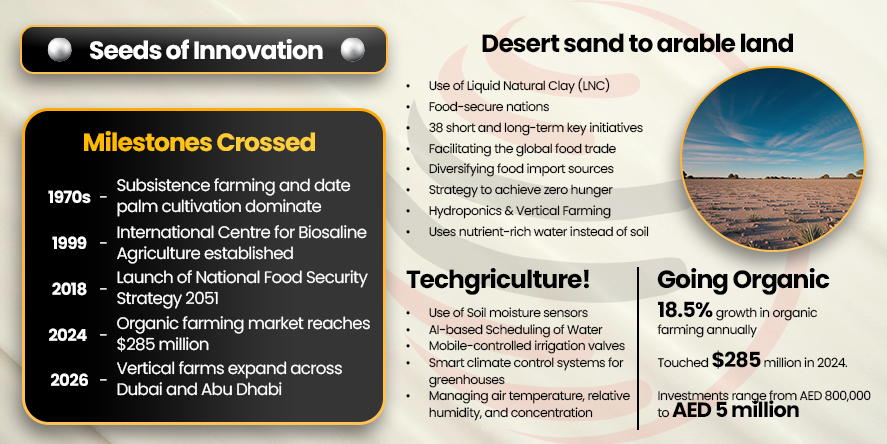
(a) Use of Soil moisture sensors,
(b) AI-based Scheduling of Water, and
(c) Mobile-controlled irrigation valves.
Smart climate control systems for greenhouses are commonly utilised in the UAE to manage air temperature, relative humidity, and concentration.
Twin factors, desert farming and government initiatives are enabling conversion of desert sand into arable land using technologies like Liquid Natural Clay (LNC), which increases soil water-holding capacity, and developing heat-resistant high-protein wheat. Further, the UAE’s agricultural journey is deeply intertwined with its National Food Security Strategy 2051, which aims to make the country one of the most food-secure nations in the world.
The National Strategy for Food Security defines the elements of the national food basket, which includes 18 main types, based on 3 main criteria:
- Knowledge of the volume of domestic consumption of the most important products.
- Production capacity.
- Processing and nutritional needs.
The strategy includes 38 short and long-term key initiatives and is aligned to strategic goals with focus on:
- Facilitating the global food trade.
- Diversifying food import sources.
- Identifying alternative supply schemes, covering three to five sources for each major food category.
The UAE’s main purpose of launching the National Food Security Strategy 2051 is to achieve zero hunger by ensuring access to safe, nutritious and sufficient food all year round. The strategy specifically aims to implement resilient agricultural practices that increase productivity and production, that help maintain ecosystems.
Prioritising local production
To minimise its dependence on imports for nearly 90 per cent of its food needs, the government has prioritised local production through innovative farming methods. This strategy emphasises diversification of food sources, investment in agri-tech, and partnerships with global innovators. It also encourages Emirati youth to engage in agriculture, emphasising that farming is not seen as a relic of the past but as a forward-looking career path aligned with technology and sustainability. The policy framework has created fertile ground for experimentation, allowing the UAE to become a hub for hydroponics, vertical farming, aquaponics, and smart greenhouse systems.
Hydroponics
Hydroponics has emerged as one of the most significant innovations in the UAE’s farming ecosystem. By growing plants in nutrient-rich water rather than soil, hydroponics drastically reduces water consumption—up to 90 per cent less than traditional farming methods. This is particularly vital in a country where water scarcity is a defining challenge. Vertical farming, often integrated with hydroponics, has also gained traction in urban centres like Dubai and Abu Dhabi. These farms stack crops in controlled environments, producing leafy greens and herbs regardless of external climate conditions. The combination of hydroponics and vertical farming represents a paradigm shift, allowing the UAE to cultivate crops in spaces that were previously unimaginable, from warehouses to high-rise buildings.
Organic Farming
Organic farming has also become a growing sector within the UAE’s agricultural ecosystem. Driven by consumer demand for healthier and more sustainable food options, organic farming has expanded rapidly, with the market valued at nearly $285 million in 2024. Farmers are increasingly adopting practices that avoid synthetic fertilisers and pesticides, focusing instead on natural soil enrichment and crop rotation. The government has supported this trend by offering subsidies and certification programmes to ensure organic produce meets international standards. While organic farming requires significant investment—ranging from AED 800,000 to AED 5 million depending on scale and technology—the returns are promising, both economically and socially. Organic farms not only supply local markets but also contribute to the UAE’s ambition of becoming a regional exporter of premium agricultural products.
Smart Greenhouses
Smart greenhouses represent another cornerstone of the UAE’s agricultural innovation. Equipped with sensors, artificial intelligence, and automated climate control systems, these greenhouses monitor humidity, temperature, and nutrient levels with precision. They enable year-round production of crops such as tomatoes, cucumbers, and peppers, which are staples in the Emirati diet. By optimising growing conditions, smart greenhouses maximise yields while minimising resource use. They also provide resilience against external shocks, such as extreme heat waves or sandstorms, which can devastate traditional farms. The integration of AI and robotics in these systems reflects the UAE’s broader vision of becoming a leader in technological innovation across sectors.
Aquaponics farming
Aquaponics, which combines fish farming with hydroponics, has also found a niche in the UAE’s agricultural ecosystem. In this closed-loop system, waste from fish provides nutrients for plants, while plants help purify the water for fish. Aquaponics not only produces vegetables but also supports aquaculture, diversifying the food supply. This method aligns with the UAE’s sustainability goals, as it reduces waste and creates synergies between different forms of farming. It also resonates with the cultural heritage of the region, where fishing has long been a vital livelihood.
The UAE’s agriculture ecosystem is a testament to human ingenuity and determination. From hydroponics to organic farming, from smart greenhouses to aquaponics, the country has redefined what farming looks like in desert conditions. Agriculture in the UAE is no longer about survival; it is about sustainability, innovation, and strategic growth. While challenges persist, the UAE’s commitment to food security and technological advancement ensured that farming will remain a central pillar of its economic and social landscape. The journey of agriculture in the UAE is not just about cultivating crops; it is about cultivating resilience, vision, and a future where farming thrives against all odds.
The economic and social impact of these innovations is profound. Agriculture, once a marginal sector, is now contributing to job creation, technological development, and youth engagement. Emirati youth are being encouraged to pursue careers in agri-tech, blending traditional knowledge with modern science. This generational shift has ensured continuity and innovation, making farming a respected and viable profession. Moreover, the emphasis on local production strengthened food security, reducing reliance on imports and enhance resilience against global supply chain disruptions. The COVID-19 pandemic underscored the importance of self-sufficiency, and the UAE’s agricultural ecosystem has responded by accelerating domestic production.
FACT FILE
Key Government Initiatives
- National Food Security Strategy 2051.
- UAE Green Agenda 2030.
- Mohammed bin Rashid Al Maktoum Solar Park.
- Organic Agriculture Development Programme.
- Smart Agriculture Initiative.
- Government support like subsidies for farmers, establishment of research centres like the International Centre for Biosaline Agriculture (ICBA) with focus on salt-tolerant crops.
Farming Innovations in the UAE
- Hydroponics & Vertical Farming.
- Uses nutrient-rich water instead of soil.
- Reduces water consumption by up to 90% compared to traditional farming.
- Vertical farms in Dubai and Abu Dhabi produce leafy greens year-round.
Organic Farming
- The organic farming sector grew 18.5% annually, reaching $285 million in 2024.
- Investments range from AED 800,000 to AED 5 million depending on scale and technology.
- Organic produce is increasingly popular among health-conscious consumers.
Smart Greenhouses
- Equipped with sensors and AI to monitor humidity, temperature, and nutrient levels.
- Enable year-round production of tomatoes, cucumbers, and peppers.
Aquaponics
- Combines fish farming with hydroponics.
- Waste from fish provides nutrients for plants, creating a closed-loop system.
Economic and Social Impact Youth Engagement:
Programmes encourage Emirati youth to enter agri-tech fields, ensuring Generational continuity.
Job Creation: Farming innovations generate employment in technology, logistics, and food processing.
Food Security: Reduced reliance on imports strengthens resilience against global supply chain disruptions.
Future Outlook
- By 2051, the UAE aims to be a global hub for sustainable agriculture.
- Integration of AI, robotics, and blockchain will enhance efficiency and traceability.
- Regional collaborations across the Gulf are expected to strengthen collective food security.
Water Use Comparison
- Traditional farming: 100 litres per kilogram of lettuce.
- Hydroponics: 10 litres per kilogram of lettuce.
- Saving: Up to 90%.
Timeline of UAE Agriculture Milestones
1970s: Subsistence farming and date palm cultivation dominate
1999: International Centre for Biosaline Agriculture established
2018: Launch of National Food Security Strategy 2051
2024: Organic farming market reaches $285 million
2026: Vertical farms expand across Dubai and Abu Dhabi
Top Crops in Controlled Environments
- Leafy greens (lettuce, kale, spinach)
- Tomatoes (including greenhouse-grown)
- Cucumbers
- Herbs (basil, mint, coriander)
- Cabbage
- Eggplant
- Squash and cauliflower
- Peppers
Other Crops
- Fruits: Other than dates, the UAE grows citrus fruits and mangoes
- Forage & Fodder: Alfalfa is a major crop grown to support the local livestock industry
- Emerging Crops: The UAE is experimenting with sustainable farming to grow crops like rice and wheat using artificial soil technology.
Soil Fertilisation
- The sandy soil in the UAE is characterised by low fertility levels, low clay mineral content, organic matter, and an inability to retain water and nutrients.
- Results from the soil survey conducted by ICBA in collaboration with the Environment Agency – Abu Dhabi (2009-2010) revealed that two-thirds of the country’s land is unsuitable for irrigated agriculture, while one-third of the land is considered marginal and low-yielding
By Imtiaz Ahmed Shariff