
The story of the UAE’s yacht segment is one of ambition meeting opportunity, where desert skylines merge with ocean horizons to create a new capital of maritime luxury. Today, the industry has reached a defining moment: yachting has claimed centre stage in the Emirates’ narrative of global connectivity and lifestyle leadership.
The UAE yacht segment has matured into a global hub for luxury maritime activity, driven by mega-marina developments, government-backed strategies, and rising demand from ultra-high-net-worth residents. Favourable tax conditions, world class marina infrastructure, weather suitable for year round cruising have boosted Yacht sales in the UAE. Dubai and Abu Dhabi now rival traditional Mediterranean centres, positioning the Emirates as a winter base and ownership hotspot for superyachts. In 2023, yacht ownership and investment got a boost as the UAE government introduced a new Maritime Law, replacing 1891 legislation.
Tagging of the Golden Visa for superyacht ownership and maritime professionals has further strengthen this sector and enabled its expansion. What adds to the growth of this maritime sector in UAE is its exceptional cruising ecosystem supported by an array of marine life like Coral reefs, diverse fish species, turtle and dolphins, abundant sunshine and crystal clear waters.
With over 1,000 kilometres of coastline, more than 15 luxury marinas, Dubai’s location between East and West makes it an ideal base for a range of cruising regions, including both the Mediterranean and the Indian Ocean regions. This Geographical advantage has played well for Dubai within the UAE to sail ahead of others in the region and has put it a nautical mile ahead. According to the Superyacht Times report, owners in the Arabian Gulf states now account for 5.3% of the global superyacht fleet. There are currently over 311 privately owned superyachts measuring more than 30 metres across these countries, with UAE residents accounting for 48% of them – -an increase of 4% since 2023. This is an indicator of stable growth within the Dubai superyacht industry, despite the effects of geopolitical tensions which were predicted to take a toll on yacht sales and ownership.
From Trade Ports to Luxury Harbours
For decades, the UAE’s maritime identity was anchored in trade, container terminals, oil exports, and logistics corridors. But as wealth migrated eastward and the Emirates positioned themselves as lifestyle destinations, yachts became more than leisure vessels; they became symbols of residency, capital migration, and cultural prestige. Today, Dubai hosts 22 marinas with over 3,750 wet berths and 640 dry berths, while Abu Dhabi has invested billions into dedicated yacht zones along its coastline.
Charter bookings in the UAE increased by around 379% between 2019 and 2023, while charters in the wider Arabian Gulf rose by approximately 283% over the same period.
Government Vision & Infra Boost
The Abu Dhabi Maritime Strategy (2024) allocated 3 billion AED toward port modernisation and yacht-specific facilities. Dubai Maritime City’s Phase 3 expansion added superyacht servicing areas capable of accommodating vessels up to 100 meters. Sharjah’s Hamriyah Free Zone incentivised international shipbuilders, creating a cluster of marine businesses. These initiatives reflect a clear ambition: to position the UAE among the top five global maritime nations by 2030.
The Rise of Superyacht Ownership
The UAE boasts one of the highest superyacht-to-billionaire ratios globally. Demand in the over 24 million category continues to rise, driven by resident UHNW families and entrepreneurs. Unlike seasonal Mediterranean hubs, the Emirates offer year-round berthing, simplified customs, and integrated luxury ecosystems – marinas that double as lifestyle districts with retail, dining, and entertainment.
A Barometer of Change
The Dubai International Boat Show (DIBS), where the global yachting elite come together, has become the sector’s flagship event. The 2026 show, the 32nd edition slated from November 25 to November 29, 2026, is likely to showcase builders like Gulf Craft, Azimut, Ferretti, Sunseeker, and Princess Yachts. The Superyacht Avenue is set to showcase luxury yachts, highlighting the latest in design, innovation, and craftsmanship. More than a showcase, DIBS functions as a relationship-driven marketplace, where brokerage deals, charter planning, and discreet asset rotations occur. Attendance figures – over 4,300 VIPs in 2025 – underscore its role as a controlled-access environment for serious buyers rather than mass-market visitors.
Marina Developments Reshaping the Coastline
Marina construction is the clearest indicator of sector health. In 2026, at least seven major marina projects are underway across the Emirates. Dubai Harbour’s western expansion added 250 new berths for yachts between 30 to 60 meters, complete with customs clearance, fuel stations, and provisioning centres. Abu Dhabi’s Yas Marina and Al Raha Beach developments are positioning the capital as a rival to Dubai, while Ras Al Khaimah and Sharjah carve niches in shipbuilding and mid-size yacht hosting.
Global Positioning
Dubai has emerged as a preferred winter destination for yacht owners and charter operators, particularly from October to April. Its appeal lies in infrastructure, timing, and climate. While Monaco, Cannes, and Genoa dominate summer launches, Dubai now offers an alternative calendar, ensuring asset utilisation beyond the Mediterranean season. This diversification is reshaping global deployment patterns, with the Gulf increasingly seen as a structural – not seasonal – market.
Economic and Cultural Impact
The yacht sector is not just about leisure – it is an economic multiplier. It fuels tourism, real estate demand, and high-value employment. Crew services, technical maintenance, and provisioning industries are expanding, creating thousands of jobs. Waterfront developments integrate marinas with luxury residences, ensuring that yacht ownership is embedded in lifestyle ecosystems. The cultural impact is equally profound: yachting has become a marker of prestige, woven into the Emirates’ narrative of modernity and global belonging.
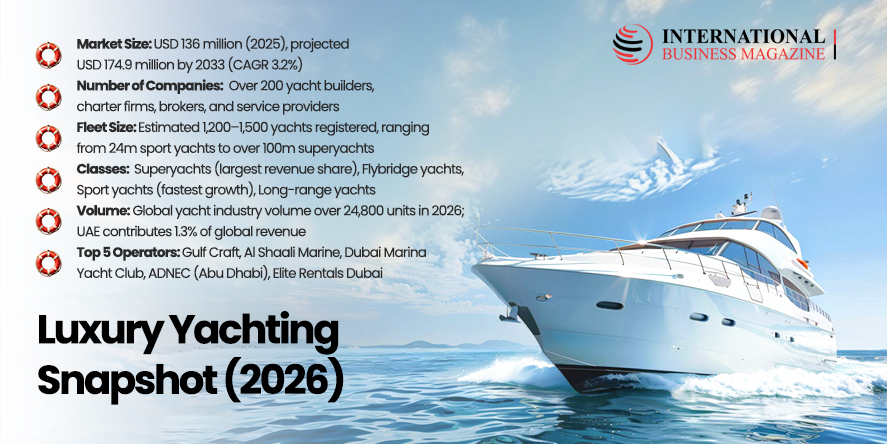
The UAE yacht industry in 2026 is valued at about USD 136 million (2025 baseline), projected to grow to USD 174.9 million by 2033, with superyachts dominating revenue and sport yachts showing fastest growth. The country hosts over 200 yacht-related companies, thousands of vessels across classes, and a rapidly expanding marina infrastructure. Top operators include Gulf Craft, Al Shaali Marine, Dubai Marina Yacht Club, Abu Dhabi National Exhibitions Company (ADNEC), and Elite Rentals Dubai.
Opportunities
The UAE is investing in sustainable yacht fuels, shore power systems, and eco-marinas, aligning luxury with responsibility. The sector’s trajectory suggests that by 2030, the Emirates will not only host yachts but shape the architecture of global yachting.
In the UAE, yachts are not just vessels – they are floating extensions of identity, wealth, and ambition, anchoring the nation’s place in the global luxury economy.
Key Developments
Marina Expansion: Dubai Harbour added 250 new berths for 30 – 60m yachts; Abu Dhabi investing AED 3 billion in yacht zones; Sharjah’s Hamriyah Free Zone attracting shipbuilders.
Superyacht Servicing: Dubai Maritime City now accommodates vessels up to 100m, reinforcing UAE’s role as a superyacht hub.
Charter Growth: Rising demand for fractional ownership and luxury tourism drives charter services.
Technology Trends: Hybrid/electric propulsion and smart yacht systems gaining traction.
Why UAE Leads in Yachting
Luxury tourism ecosystem (Dubai International Boat Show, Abu Dhabi Grand Prix).
Strategic location between Europe & Asia.
Government-backed maritime strategies aiming for “Top 5 global maritime nation by 2030.”
Article by Imtiaz Ahmed Shariff