
Compliance Management has evolved into a global ecosystem that integrates governance, technology, regulation, and culture, shaping how organisations navigate risk and build trust. Its significance varies across geographies, reflecting local regulatory intensity, economic priorities, and cultural expectations, but everywhere it has become a cornerstone of resilience and competitiveness.
Today, Compliance Management assumes importance, as management is no longer a peripheral function but a global ecosystem that integrates the dynamics of governance. It is a dynamic network of regulatory bodies, internal structures, auditors, consultants, and digital platforms that together ensure organisations remain aligned with laws, ethical standards, and stakeholder expectations. For businesses, Compliance is crucial to attract foreign investment and ensuring stability in volatile political and Geopolitical environments. Therefore, Compliance is not just about avoiding penalties; it is about enabling sustainable growth, protecting reputation, and building resilience in a volatile and complex world.
The Compliance ecosystem begins with setting up of governance structures like boards, Chief Compliance Officers, and committees that provide oversight and accountability. Government or Corporate policies and procedures support these structures. Procedures and policies translate regulatory requirements into operational commitments, monitored through controls and audits.
Increasingly, technology plays a transformative role, with AI-driven monitoring, blockchain-based transparency, and integrated Governance, Risk and Compliance (GRC) platforms automating compliance tasks and reducing human error. A distinctive feature of Compliance is that embedding integrity into organisational DNA ensures that it is proactive, not reactive. The significance of Compliance varies across geographies, reflecting local regulatory intensity, economic priorities, and cultural expectations. Across all these geographies, Compliance plays a strategic role and is necessary.
Compliance across Geographies
Compliance is not any country or business specific. Its thread sews through territories across continents. Here is a brief summary of it in different Geographies.
In North America, strict regulatory frameworks govern the financial, healthcare, and technology sectors. By adhering to strict standards enforced by the SEC, FINRA, OFAC (Office of Foreign Assets Control), and the FDA, organisations transform compliance into both a shield against litigation and a catalyst for investor confidence. Data privacy laws like the California Consumer Privacy Act (CCPA) add another layer, making Compliance essential for consumer trust in digital markets.
In Europe, General Data Protection Regulation (GDPR) dominates the ecosystem and ESG mandates. The EU’s regulatory framework emphasises data protection, sustainability, and harmonisation across member states. Compliance here is not only legal but also cultural – citizens expect transparency and ethical conduct as a baseline. Companies that follow compliance norms gain easier access to EU markets and enjoy reputational capital that translates into competitive advantage.
When it comes to adherence of Compliance rules in the Asia-Pacific region, it presents a diverse landscape. Japan and Singapore give prominence to corporate governance and financial transparency, while China and India focus on data localisation, anti-corruption, and financial inclusion. Rapid digitalisation has made cybersecurity Compliance a priority, and organisations see Compliance Management as a gateway to global competitiveness.
In India, regulatory Compliance serves multiple purposes. It safeguards the interests of stakeholders, reduces risks such as data breaches or fraud by enforcing security measures, and demonstrates corporate responsibility and commitment to societal issues and environmental concerns. Each Sector in India has its own governing body such as RBI, that overlooks banking and finance, SEBI (oversees Stock markets), FSSAI (monitors food industry), TRAI (keeps an eye on telecom services), IRDA (regulates insurance sector), and Central Drugs Standard Control Organisation (CDSCO) keeps an eye on quality of drugs, cosmetics, and medical devices manufactured, imported, and distributed in the country.
In Latin America, compliance ecosystem is evolving, with emphasis on anti-money laundering, tax compliance, and political risk management. Brazil has strengthened frameworks around digital banking and corporate governance, but enforcement remains uneven.
Financial services, energy, and trade matters in the Middle East come under the Compliance radar. Regulatory bodies focus on anti-money laundering, Sharia-compliant finance, and alignment with international standards. Transparency and governance are critical for credibility, especially as Gulf nations seek to diversify economies and attract foreign direct investment.
Africa’s Compliance ecosystem is still developing, with emphasis on anti-corruption, resource management, and financial inclusion. International organisations often play a role in drafting standards, and for businesses operating in emerging markets, Compliance Management is both a challenge and an opportunity to build trust.
Global Framework of Trust
Compliance Management is fast catching up in the countries across the globe. It plays a vital role in preventing risks by identifying and mitigating threats before they escalate. It provides regulatory intelligence, helping organisations stay ahead of global changes and avoid sanctions that inflict huge costs. It enables business by facilitating market entry, innovation, and stakeholder trust.
In addition, Compliance becomes essential in crisis management, guiding organisations through investigations, breaches, or scandals with credibility intact. The Compliance ecosystem, therefore, is not an inelastic checklist but a global framework of trust and risk. Its significance across Geographies reflects local priorities – litigation in North America, data protection in Europe, digitalisation in Asia, governance in Latin America, transparency in the Middle East, and trust-building in Africa. Yet the common thread is clear: effective Compliance is the foundation of sustainable business in a volatile world, a strategic enabler of resilience and growth that transcends borders and industries.
Today, in this complex and fast changing world, nature of business, and technology, Compliance Management has the flexibility and ability to absorb changes be it in legislation, business models, emerging technologies, and Geopolitical realities.
The Lowdown: What PwC Study finds
PwC during its Global Compliance Study, 2025 found some key priorities identified by organisations.
Business Conduct
- Cybersecurity 51%
- Data Protection and Privacy 51%
- Corporate governance 40%
Technology
- Anti-bribery and corruption, anti-money laundering 38%
- Environmental and sustainability (Disclosure reporting) 30%
- Industry specific regulations 30%
- Third Party supply chain management 28%
- Artificial Intelligence 26%
Products
- Financial management and reporting 29%
- Product compliance 26%
*Source: PwC’s Global Compliance Study 2025
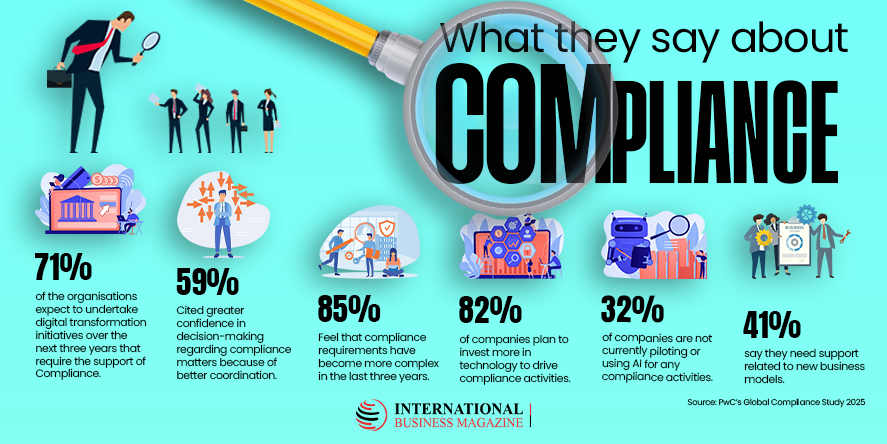
What they say about COMPLIANCE
71% of the organisations expect to undertake digital transformation initiatives over the next three years that require the support of Compliance.
41% say they need support related to new business models.
85% Feel that compliance requirements have become more complex in the last three years.
59% Cited greater confidence in decision-making regarding compliance matters because of better coordination.
32% of companies are not currently piloting or using AI for any compliance activities.
82% of companies plan to invest more in technology to drive compliance activities.
Source: PwC’s Global Compliance Study 2025
.
Four Key Roles of Compliance
- Proactive Risk Identification
- Regulatory Intelligence
- Business Enablement
- Crisis Management
Top 10 Compliance Management Software Platforms
- MetricStream
- RSA Archer
- NAVEX Global
- Vanta
- Sprinto
- Complinity
- LogicGate Risk Cloud
- SAP GRC
- Hyperproof
- One Trust
- StandardFusion
- Quantitative GRC
- Zen GRC
- iGrafx GRC
.
The Role of Technology
Artificial Intelligence (AI) & Machine Learning (ML): Used for tasks such as predictive analytics for emerging risks, automated monitoring of communications, and intelligent document review.
Block chain: Usedfor immutable records, providing support transparency in supply chains and financial transactions.
Cybersecurity Tools: To protect sensitive information Cybersecurity Tools are used.
.
Article by Imtiaz Ahmed Sharif
For more information on compliance management, please check
Tax Star Partners with Wafeq to Boost Corporate Tax Compliance in UAE
Ensuring Workplace Safety Compliance: A Guide to Health Management System Audits