
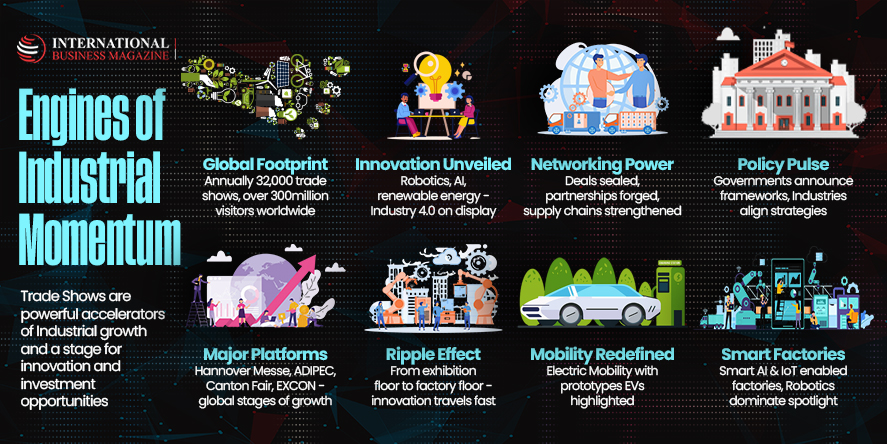
International Trade shows are more than bustling exhibition halls; they are crucibles where industries reinvent themselves. Each booth becomes a stage for innovation, where machinery hums, prototypes gleam, and conversations spark collaborations that ripple far beyond the venue. For manufacturers, these gatherings are launch pads – introducing automation breakthroughs, sustainable materials, and digital solutions that redefine efficiency.
Emerging enterprises find their footing at trade shows, gaining visibility and forging trust with potential partners. Established players, use the spotlight to expand into new geographies, strengthen supply chains, and announce bold product lines. Trade shows are accelerators – bridging supply and demand, igniting innovation, and weaving networks that drive industrial growth forward.
Trade shows are not merely exhibitions; they are engines of industrial momentum, shaping the way industries evolve and economies expand. Their importance lies in the unique ecosystem they create – bringing together all the stakeholders under one roof. In this concentrated environment, ideas are exchanged, collaborations are forged, and investments are catalysed, setting the stage for growth that reverberates far beyond the exhibition halls.
The scale of trade shows underscores their significance. Globally, the exhibition industry hosts tens of thousands of events annually, drawing millions of visitors and generating billions in economic impact. Exhibitions generated Euro 298.7 (USD 334.5) billion of total output (total business sales) in 2019. Based on a global total of 4.8 million exhibitors in 2019, total output per exhibitor amounted to Euro 62,864 (USD 70,382). North America ranked first with Euro78,716 (USD 88,130) in total output per exhibitor. Europe and Asia/Pacific followed with Euro70,027 (USD 78,403) and Euro 49,082 (USD 54,952) in total output per exhibitor, respectively.
These gatherings at the trade shows are active marketplaces of ideas and technologies. For emerging enterprises, trade shows provide visibility and credibility, offering a chance to connect with potential clients and benchmark against established players. For established industries, they serve as launch pads for new products, platforms for expanding into new geographies, and stages for strengthening global networks. Among the most influential trade shows worldwide, Hannover Messe in Germany stands out as a beacon of industrial innovation. Known as the world’s leading industrial technology fair, it highlights automation, robotics, energy solutions, and digital manufacturing. EMO Hannover, focusing on machine tools and manufacturing technology, draws global attention to precision engineering.
In Abu Dhabi, ADIPEC has become a cornerstone for the energy sector, displaying advancements in oil, gas, and increasingly renewable energy. In Asia, China Import and Export Fair (Canton Fair) remains one of the largest trade events, spanning multiple industries and connecting global buyers with Chinese manufacturers. India too plays host to significant gatherings such as EXCON in Bengaluru, Asia’s largest construction equipment exhibition, and IMTEX in Bengaluru, which emphasises metal forming and machining technologies. These events are not isolated spectacles; they are interconnected nodes in a global industrial network. The innovations revealed at these trade shows often set the tone for industrial progress.-
In recent years, automation and robotics have dominated the spotlight, reflecting the rise of Industry 4.0. Smart factories, powered by AI and IoT, are showcased with live demonstrations of robotic arms, predictive maintenance systems, and digital twins. Renewable energy technologies – solar panels, wind turbines, hydrogen solutions, and energy storage systems -are increasingly prominent, aligning with global climate goals. Healthcare and medical technology expos reveal breakthroughs in biotechnology, telemedicine, and digital health platforms, underscoring the cross-sectoral impact of trade shows. Automotive exhibitions highlight electric mobility, with prototypes of EVs, charging infrastructure, and smart transportation solutions.
The ripple effect of these innovations is profound. When a new automation tool is unveiled at Hannover Messe, it does not remain confined to the exhibition floor; it travels across industries, reshaping production lines in Asia, Europe, and the Americas. Renewable energy solutions displayed at ADIPEC or Enlit Europe influence policy frameworks and corporate strategies, accelerating the global energy transition. Even niche expos like Formnext Frankfurt, which focuses on additive manufacturing, have global consequences, pushing industries toward 3D printing and customized production.
Trade shows also serve as policy incubators. Governments often use these platforms to announce industrial initiatives, regulatory frameworks, or infrastructure projects. The dialogues that emerge between policymakers and industry leaders help align national strategies with global trends. For example, India’s emphasis on “Make in India” resonates strongly at events like EXCON and IMTEX, where international exhibitors engage with domestic manufacturers to strengthen local supply chains. The cultural dimension of trade shows also play a positive role in development of business.
Trade Shows also act as melting pots of ideas, where cross-border collaborations are born. A robotics startup from Taiwan may find investors in Germany; a renewable energy firm from Spain may secure contracts in the Middle East. So far, with over 32,000 trade shows, and 300 million visitors worldwide, this global networking ensures that industries remain agile, adaptive, and competitive in an ever-changing landscape.
Conclusion
Trade Shows are accelerators of industrial growth because they bridge gaps between supply and demand, foster trust, and ignite innovation. They compress years of networking, research, and negotiation into a few days of concentrated activity. The industrial world thrives on momentum, and trade shows provide precisely that – momentum that carries industries forward into new eras of productivity, sustainability, and technological advancement.
Major Trade Shows
The Global “Big Three”
1. Hannover Messe (Hanover, Germany)
• The Vibe: The undisputed heavyweight champion of the industrial world.
• Focus: Full-scale industrial transformation. This is where the concepts of Industry 4.0, smart factories, and AI-driven production logistics are defined and debuted on a massive global scale.
• Scale: Typically features over 4,000+ exhibitors and draws well over 130,000 international attendees annually.
2. IMTS – International Manufacturing Technology Show (Chicago, USA)
• The Vibe: The largest manufacturing and machine tool show in the Western Hemisphere.
• Focus: Heavy focus on precision metalworking, CNC machinery, robotics, aerospace/automotive manufacturing, and advanced additive manufacturing (3D printing).
• Frequency: Held biennially (every even-numbered year) at McCormick Place.
3. JIMTOF – Japan International Machine Tool Fair (Tokyo, Japan)
• The Vibe: Asia’s premier launchpad for cutting-edge automation and machine tool tech.
• Focus: High-end tooling, extreme precision engineering, advanced robotics, and heavy industrial machinery. Japan’s top manufacturing giants use this show to debut their most sophisticated proprietary systems.
Major Specialised & Regional Powerhouses
• FABTECH (Rotating US Cities): North America’s largest event dedicated exclusively to metal forming, fabricating, welding, and finishing. For raw metal processing, this is the definitive show.
• SPS – Smart Production Solutions (Nuremberg, Germany): The absolute epicentre for industrial automation and electrical components. It focuses heavily on the brains of the factory floor – PLCs, sensors, drive technologies, and control software.
• Manufacturing Indonesia (Jakarta, Indonesia) / Manufacturing Expo (Bangkok, Thailand): The two dominant mega-shows anchoring the rapidly expanding Southeast Asian industrial landscape, focusing on cost-effective machinery and supply chain infrastructure.
• India Manufacturing Show / IMTEX (Bengaluru, India): South Asia’s flagship industrial and machine tool exhibitions, driving massive B2B investment in regional manufacturing prowess.
Article by Imtiaz Ahmed Shariff