

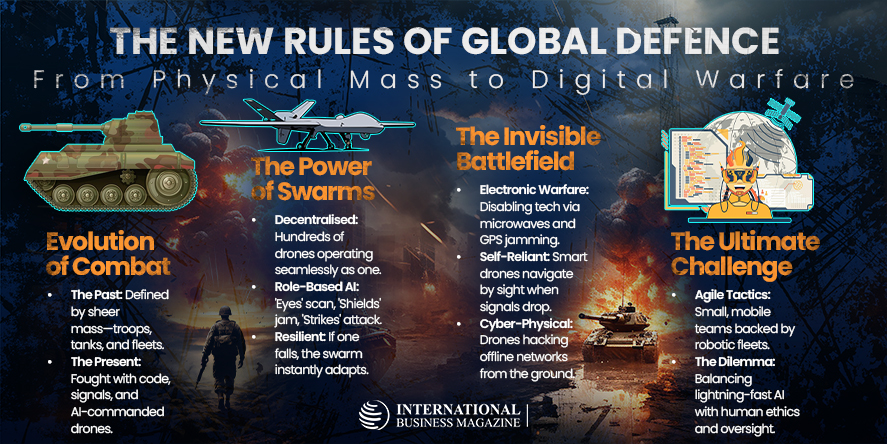
For generations, global military power was measured by sheer physical mass: the number of troops, the thickness of armour on tanks, and the size of naval fleets. Warfare was fundamentally a clash of metal and muscle. Today, however, the rules of global defence have permanently changed. A new era has emerged where conflicts are fought not just on physical battlefields, but in the invisible realms of code, signals, and autonomous machines.
The defining weapon of this new age is no longer the heavy artillery piece; it is the drone, and more importantly, the artificial intelligence that commands it. This change from conventional combat to digital warfare is reshaping global security, transitioning from remote-controlled gadgets to fully automated systems that think and react faster than humanly possible.
The Power of the Swarms
To understand this shift, it is necessary to look past the consumer drones seen delivering packages or filming neighbourhood events. Military unmanned systems have evolved dramatically. Previously, a military drone was essentially a remote-controlled plane or a flying camera, piloted by a human sitting at a desk thousands of miles away with a joystick and a video feed. Today, the focus has shifted entirely toward the concept of “swarms”.
Imagine a flock of birds swooping and diving in perfect harmony across the sky without a single leader dictating their every move. Drone swarms operate on the very same principle. Instead of one human piloting one machine, hundreds of small, relatively inexpensive drones are launched at once, communicating with each other in real time. If one drone crashes or is intercepted, the rest of the swarm instantly adjusts and continues the mission without missing a beat.
Within this swarm, different drones automatically take on different roles. Some act as the “eyes”, scanning the ground below; others act as the “shield”, intentionally confusing enemy radars; and others carry out the physical strike. This collective, artificial intelligence makes them incredibly difficult to defend against. It effectively turns a group of cheap, replaceable machines into a coordinated force that can overwhelm traditional, multimillion-dollar defence systems simply through speed and sheer numbers.
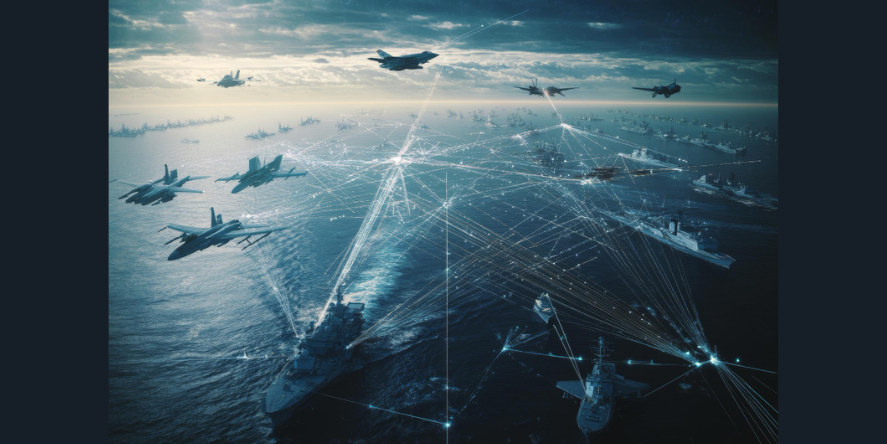
The Invisible Battlefield of Electronic Warfare
But what happens when an opponent tries to cut the invisible strings controlling these machines? This introduces the hidden front line of modern conflict: electronic warfare. In a digital conflict, controlling the airwaves is just as important as controlling the physical ground.
Militaries now use invisible energy like microwaves, radio waves, and lasers to disable enemy technology. They can scramble GPS signals so that drones completely lose their sense of direction, or they can flood communication channels with digital noise, essentially blinding or deafening the machines, thus, preventing them from receiving any orders.
To counter this, the newest generations of drones are becoming smarter and more self-reliant. They no longer depend exclusively on global positioning satellites. Instead, they use built-in cameras to look at the ground, comparing the rivers, roads, and mountains they see against digital maps stored in their memory. They navigate by sight, much like how a human pilot would, looking out a window. They also use artificial intelligence to detect when their communication signals are being jammed, allowing them to instantly hop to clear channels. The ultimate goal is to create machines that can survive and continue functioning perfectly even when their digital lifelines to the outside world are completely severed.
Merging the Physical and Digital Worlds
This new era also blurs the line between physical attacks and cyber warfare. In the past, a computer hacker and a front-line soldier fought entirely different battles in entirely different worlds. Today, they work hand-in-hand.
For example, a strategic cyberattack might be launched to quietly shut down an opponent’s air defence grid just seconds before a physical drone swarm flies into the area. Conversely, a physical drone might be used to carry out a cyberattack. A small, silent drone could land on the roof of a highly secure facility, connect to the building’s internal wireless network, and covertly steal data or inject computer viruses into closed systems that are completely disconnected from the wider internet.
This seamless integration means that a modern defence system must be prepared for threats that attack from the sky and through the internet simultaneously. Defence commanders must now rely on advanced computer algorithms to instantly process massive amounts of information, helping them decide in split seconds whether to respond to an incoming threat with a physical interceptor or a string of defensive computer code.
The Future of Global Security
As this technology advances, it is changing the very nature of global security and tactics. Large, slow-moving armies concentrated in one place are becoming increasingly vulnerable to fast, automated strikes. The future points toward smaller, highly mobile teams of personnel who are supported by their own dedicated fleets of robotic assistants, both in the air and on the ground.
However, the most profound challenge faced in this new era is not technological, but ethical. As machines become increasingly capable of identifying targets and making strategic decisions at lightning speed, how much control should be handed over to artificial intelligence? The speed of modern digital warfare demands faster reactions, but the permanent consequences of conflict demand human judgement and morality. Finding the right balance between machine efficiency and human oversight is the greatest test of this new defence era. Ultimately, the future of global security will not just be about who builds the fastest drones, but also about who can manage this profound digital power responsibly.
Article by Charan MS