
The evolution of electric vehicles is not a uniform story – it unfolds differently across continents, shaped by policy, infrastructure, consumer behaviour, and industrial ambition. To grasp their importance, we must look at how each region is navigating the transition, what challenges remain, and whether EVs alone can carry the weight of global sustainability goals.
Based on data from the International Energy Agency, Norway ranks first among the six leading countries for electric vehicle sales share, where EVs constitute the largest percentage of total vehicle sales. Electric vehicles made up 92 per cent of passenger vehicle sales in 2024 in Norway), in Sweden (58 per cent), in Denmark (56 per cent), in Finland (50 per cent), and the Netherlands and China (tied at 48 per cent). Meanwhile, the United States ranks much lower, with EVs at just 10 per cent of passenger car sales. According to a report in Gasgoo, an Online Automotive News, the global electric vehicle sales rose 20 per cent to approximately 23 million units in 2025, driven by China’s 16 million units and a 33 per cent increase in Europe.
Europe: Regulation as the Driving Force
Europe has positioned itself as the vanguard of EV adoption. The European Union’s Green Deal (to cut emissions by at least 50 per cent by 2030, rising towards 55 per cent, while legally binding the 2050-neutrality goal through the European Climate Law) and strict emission standards have forced automakers to accelerate electrification. Countries like Norway, where EVs account for over 80 per cent of new car sales, display what happens when subsidies, charging infrastructure, and consumer incentives align. Germany and France are investing heavily in battery gigafactories to reduce dependence on Asian imports, while the UK has set a 2035 deadline for phasing out new ICE sales. Yet, challenges remain – charging infrastructure in rural areas lags, and affordability is still a barrier for middle-income households.
North America: Market-Driven Momentum
In the United States, EV adoption is driven by a mix of federal tax credits, state-level mandates, and consumer enthusiasm for brands like Tesla. California leads with aggressive zero-emission vehicle targets, while states in the Midwest and South remain slower to adopt. Canada, with its vast geography, faces infrastructure hurdles but is investing in nationwide charging corridors. The U.S. Inflation Reduction Act has further boosted domestic EV production, tying subsidies to local manufacturing and supply chains. North America’s EV story is less about regulation and more about market innovation-consumers are drawn to performance, technology, and the prestige of owning cutting-edge vehicles.
Asia: Scale and Strategy
China is the undisputed leader in EV adoption, accounting for more than half of global EV sales. State-backed policies, subsidies, and industrial planning have created giants like BYD and NIO. The government’s push for electric buses in cities has transformed public transport, while aggressive investment in battery technology has made China the world’s largest battery producer. Japan and South Korea, though slower in EV adoption, are betting heavily on hydrogen fuel cells, seeing them as complementary to EVs.
Africa: Emerging but Essential
Africa’s EV journey is nascent but crucial. With rapid urbanisation and growing middle-class demand for mobility, electrification could leapfrog traditional ICE infrastructure. Countries like South Africa and Kenya are experimenting with solar-powered charging, leveraging abundant renewable resources. Challenges include affordability, limited charging networks, and reliance on imported vehicles. Yet, the potential is immense – EVs could reduce dependence on costly fuel imports and improve urban air quality.
Latin America: Gradual but Growing
Latin America faces unique hurdles: Economic volatility, limited infrastructure, and high vehicle costs. Yet, countries like Brazil, Chile, and Mexico are making strides. Chile has pledged to electrify public transport fleets, while Mexico is emerging as a hub for EV manufacturing due to proximity to the U.S. market. Here, the focus is less on private EV ownership and more on public transport electrification, which offers broader social and environmental benefits.
Growing Numbers and the Giants
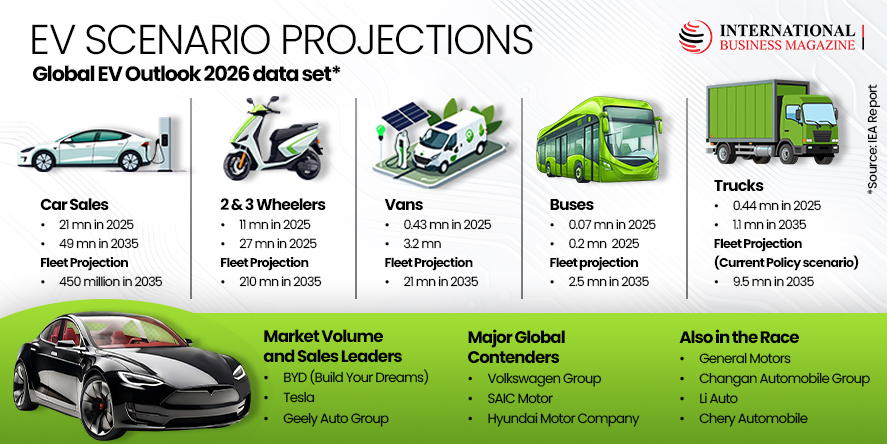
As the movement for Green mobility is gaining traction across the Continents, the automotive companies are scaling up the production of EVs. According to the Global EV Outlook 2026 data set from the IEA report, EV sales and fleets are growing across all vehicle types, led by market volume leaders BYD, Tesla, and Geely Auto Group.
Here are some sales numbers and projections. a) Cars: 21 million sold in 2025, rising to 49 million in 2035 with a fleet projection of 450 million. b) Two and Three Wheelers: 11 million sold in 2025, reaching 27 million, with a fleet projection of 210 million in 2035. c) Vans: 0.43 million sold in 2025, reaching 3.2 million, with a fleet projection of 21 million in 2035. d) Buses: 0.07 million sold in 2025, reaching 0.2 million, with a fleet projection of 2.5 million in 2035. e) Trucks: 0.44 million sold in 2025, rising to 1.1 million in 2035, with a current policy fleet projection of 9.5 million in 2035.
Top sales giants like BYD, Tesla, and Geely Auto Group lead the global automotive market. They face major global contenders such as the Volkswagen Group, SAIC Motor, and Hyundai Motor Company, while other competitive brands like General Motors, Changan Automobile Group, Li Auto, and Chery Automobile remain very active in the ongoing race.
Are EVs the Only Solution?
The narrative often frames EVs as the inevitable replacement for ICE vehicles, but the reality is more nuanced. Other technologies are emerging.
Hydrogen fuel cells: Particularly promising for heavy-duty transport and long-haul trucking, where battery weight and charging times are limiting factors.
Synthetic fuels: Produced using renewable energy, they could allow existing ICE infrastructure to operate with lower emissions.
Hybrid vehicles: A transitional technology, hybrids reduce emissions while leveraging existing fuel networks.
Public transport electrification: Beyond personal cars, electrifying buses, trains, and urban mobility systems may yield greater sustainability gains.
The Future of ICE Vehicles
ICE vehicles are not disappearing overnight. Their future depends on geography, economics, and regulation: In Europe, bans on new ICE sales are set for 2035, signalling a clear sunset. In North America, states like California are leading similar initiatives, though rural regions may resist. In Asia, China and India are balancing EV growth with continued ICE demand, especially in lower-cost segments. In Africa and Latin America, ICE vehicles may persist longer due to affordability and infrastructure challenges. Rather than extinction, ICE vehicles may evolve – powered by synthetic fuels, hybrid systems, or relegated to niche roles where electrification is impractical.
A Plural Future
While EVs dominate headlines, the future of mobility will likely be plural, with EVs dominating urban and consumer markets, hydrogen powering freight, and synthetic fuels sustaining aviation and shipping. Hybrid vehicles provide transitional solutions in regions where infrastructure lags. The global transport future will be diverse, with EVs at the centre but not alone.
Article by Imtiaz Ahmed Shariff