
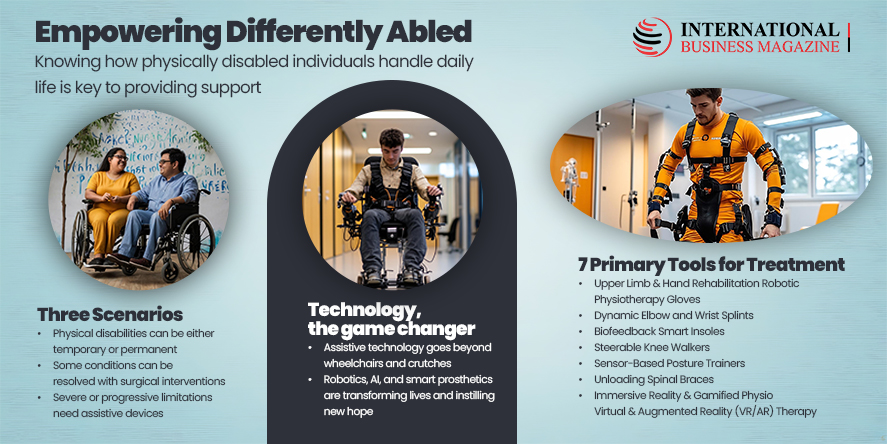
Understanding how individuals with physical disabilities manage their daily life activities is essential for providing effective care and support. Physical disabilities can be either temporary or permanent, and they affect individuals differently based on severity. While some conditions can be resolved with surgical interventions, more severe or progressive limitations need assistive devices. Orthopaedics help the differently abled with treatment and suggest what kind of assistive gear they require.
The term orthopaedic was coined in the 1700s and orthopaedic principles were used during primitive times to help physically affected persons. The Egyptians continued to use these practices. The Greeks and Romans later explored medicine in a structured manner, improving knowledge of orthopaedic anatomy and enhancing surgical skills. During the middle Ages, Renaissance improved the surgical techniques and set up orthopaedic hospitals. Collectively, these advances provided the foundation for modern orthopaedics.
Today, advances in technology and digital tools like the Internet of Things (IoT), Artificial Intelligence, next-generation telecommunication networks, big data analytics, blockchain technologies and sensors are shaping the field of orthopaedic surgery at all levels. Therefore, modern assistive technology is not just reshaping industries and economies – it is profoundly transforming the daily lives of orthopaedically challenged people, enabling them to live with greater independence, and achieve competitive excellence. Paralympic Games are the best example of competitive excellence.
.
Impact of Assistive Technology
The story of assistive technology goes beyond wheelchairs and crutches; it now spans robotics, Artificial Intelligence, smart prosthetics, robotic exoskeletons, and digital ecosystems that integrate seamlessly into everyday routines. At the core of this transformation are new technologies that have already entered mainstream. Smart prosthetics, for instance, are no longer passive limbs but intelligent extensions of the body. Powered by sensors and microprocessors, they can detect muscle signals and translate them into precise movements, allowing amputees to walk, run, or even grip objects with good dexterity. Wheelchairs, once static, are now electric, voice-controlled, and even capable of climbing stairs or navigating uneven terrain. Exoskeleton suits, worn like robotic armour, enable individuals with spinal injuries to stand, walk, and perform tasks that were once unimaginable.
These devices are not just tools – they are bridges to independence, helping people reclaim mobility and confidence in their daily lives. Beyond what is already available, emerging technologies promise to push boundaries further. Scientists are developing Brain-Computer Interface (BCI) to let direct communication between neural signals and external devices, enabling control of wheelchairs, prosthetics, or even computers purely through thought. The 3D printing is revolutionising prosthetic design by making customised, affordable, and lightweight limbs accessible to a wider population.
.
AR, VR Redefining Accessibility
Technology knows no bounds. Medical care providers are using Augmented Reality (AR) and Virtual Reality (VR) for rehabilitation of physical disabled persons, offering them immersive environments where patients can practice motor skills, balance, and coordination in safe, controlled settings. These innovations are not futuristic fantasies – they are today’s reality redefining accessibility. The impact of these technologies is not limited to daily living; they are also reshaping the world of sports for disabled persons, particularly in arenas like the Paralympics. Athletes with prosthetic running blades, for example, are achieving speeds that can rival able-bodied sprinters. Wheelchair basketball and tennis games played with chairs engineered for agility, speed, and precision are new normal for disabled persons.
.
Exoskeletons Changing Lives
Advanced training tools, including motion sensors and AI-driven analytics, help athletes refine their techniques and optimise performance. Use of wearable robotic exoskeletons provide strength and balance to patients with nerve and muscle damage. Beyond rehabilitation, Exoskeletons are used in competitive sports, potentially opening new categories of athletic participation. The Paralympics today stand as a symbol of how technology can level the playing field, allowing athletes with disability to display skill, determination, and excellence.
Flexible lightweight exoskeletons and soft robotic garments to replace conventional rigid exoskeletons are the next level of invention. Flexible lightweight exoskeletons with smart control systems replace crutches. These exoskeletons enhance the function of damaged body parts in stroke and paraplegia patients. Soft robotic exoskeletons give the natural feel as a body and environmental sensors that determine emergencies when the user needs special assistance power them. For example, when walking on an uneven road or going up a flight of stairs, the sensors built into the fabric will automatically employ artificial muscles to give added strength and stability to the wearer.
.
AI helping personalise rehabilitation
Artificial Intelligence in assistive technology is helping in personalising rehabilitation programmes by analysing patient progress and adapting exercises in real time. AI-powered apps provide navigation assistance for wheelchair users, suggesting accessible routes and alerting them about obstacles. In prosthetics, Machine Learning algorithms interpret subtle muscle signals accurately, making movements smoother and more intuitive. AI-driven speech recognition tools are enabling those with limited mobility to control devices, communicate, and work more effectively. Artificial intelligence facilitates robotic rehabilitation to aid arm and hand movement, provides assessment tools for motor skills like handwriting and motion, and supports remote rehabilitation systems that enable therapy at home.
Smart home technologies, which allow voice or gesture control of lights, appliances, and doors, reducing dependence on caregivers is transforming lives of physically disabled persons. Transportation is also becoming more inclusive, with AI-enabled ride-hailing services offering wheelchair-accessible vehicles and autonomous cars promising even greater independence. Not to be left behind, education and employment segments are also helping disabled persons to be part of the inclusive system. Digital platforms are providing flexible opportunities for learning and remote work.
The narrative of modern technology for orthopaedically challenged people is, therefore, one of empowerment. It is about moving from survival to thriving, from dependence to autonomy, and from exclusion to inclusion. The convergence of robotics, AI, smart devices, and digital ecosystems is not just enabling mobility – it is enabling dreams, ambitions, and achievements that transcend physical limitations.
.
Conclusion
As technology continues to evolve, the horizon for orthopaedically challenged individuals expands ever wider, promising a future where disability is no longer a barrier but another aspect of human diversity. In this continuous unfolding of innovation, one fact stands clear: modern technology is not merely assisting, it is liberating. It is giving orthopaedically challenged people the tools to write their own stories, to compete, to excel, and to live with the fullness of human possibility. As AI deepens its role, the future may be one where machines do not just serve but understand, adapt, and empower – making accessibility not an exception but the norm.
.
Companies Manufacturing Assistive Devices
Prosthetics & Orthotic
Össur (Iceland)
- Known for advanced prosthetic limbs and orthotic supports.
- Products include bionic knees, feet, and braces.
- Focus on lightweight, functional designs for everyday mobility.
Ottobock (Germany)
- Global leader in prosthetics, wheelchairs, and exoskeletons.
- Innovations include the C-Leg microprocessor knee and Michelangelo Hand.
- Strong presence in rehabilitation and mobility solutions worldwide.
Rise Bionics (India, Global Reach)
- Offers custom prosthetics and orthotics using digital machining.
- Portfolio includes artificial legs, spinal braces, and foot orthotics.
- Runs initiatives like help a Child Walk to democratise access.
.
Mobility & Accessibility
Invacare Corporation (USA)
- Manufactures wheelchairs, scooters, walkers, and patient transfer equipment.
- Focus on home and long-term care solutions.
Permobil (Sweden)
- Specialises in powered wheelchairs and seating systems.
- Known for ergonomic designs and smart wheelchair technology.
Sunrise Medical (USA/Germany)
- Offers manual and powered wheelchairs, mobility scooters, and adaptive seating.
- Brands include Quickie, Zippie, and Jay.
.
Robotics & Exoskeletons
Ekso Bionics (USA)
- Develops robotic exoskeletons for rehabilitation and industrial use.
- Helps paraplegic patients regain mobility through assisted walking.
ReWalk Robotics (Israel/USA)
- Provides wearable robotic exoskeletons for spinal cord injury patients.
- FDA-approved devices for personal and rehabilitation use.
.
The Key Dates
The Dawn of Diagnostics & Metallurgy (1895–1950s)
- X-Ray Discovery (1895)
- Early Implant Metallurgy (1910s–1930s)
- Low-Friction Arthroplasty (1962)
Computer Assistance & Digital Imaging (1980s–1990s)
- Advanced Imaging: The integration of CT scansandMRIs
- Computer-Assisted Orthopaedic Surgery (CAOS) / Navigation (1990s)
- Early Robotics (1992): Introduction of the ROBODOC system
Precision Engineering & Additive Manufacturing (2000s–2010s)
- 3D Printing / Additive Manufacturing
- Refined Surgical Robots
Smart Tech, AI, & Immersive Reality (2015–Present)
- Augmented Reality (AR) & Virtual Reality (VR)
- Artificial Intelligence (AI)
- Smart Implants & Tele rehabilitation
Smart Implants & Bio-Sensing Rehabilitation
- Wireless Biomechanical Tracking
- Early Infection Catching
- Targeted Tele rehabilitation
Article by Imtiaz Ahmed Sharif
For more information on the differently abled, please check the web pages:
Navigating Life’s Uncertainties: Should You Prioritize Life Insurance or Income Protection?