
It took centuries to accept paper currency notes as legal tender without the backing of gold or silver like in the 16th Century. These paper notes do not need precious metal’s backing. More recently, paper notes are being replaced by plastic notes. However, the baggiest transformation is the emergence of Digital money, where physical currency is passé. Today, Digital banking on smartphones has no closing time. It is an era of Anywhere, Anytime is Banking Time!
Now people bank on Digital finance, a universal ecosystem where money, technology, and trust converge – an interconnected web of payments, banking, investments, insurance, and regulation, all powered by digital platforms. It is transforming how individuals, businesses, and governments interact with money, creating a seamless, borderless, and intelligent financial world.
Modern banking is built on the foundations of digital payments, blockchain networks, Artificial Intelligence, and Cloud Computing, each weaving together to create a fabric that supports the modern economy. It is not an activity confined within the four walls of banks or the accounting ledgers; instead, it flows like information – instant, invisible, and omnipresent. In the Digital finance arena, mobile wallets, QR codes, cash codes, and instant transfers are the foundation of everyday transactions, whether through India’s UPI, PayPal’s global reach, or Africa’s M-Pesa. Payments are now frictionless, real-time, and borderless. Banks collaborate with fintech startups, offering open APIs, digital-first accounts, and AI-powered personalisation, ensuring that financial services are not only accessible but also tailored to individual needs.
The Synergy of Technology
The rise of blockchain has added a new dimension to trust and transparency, the core of any form of banking system. Distributed ledgers ensure immutability and accountability, enabling secure transactions across borders without intermediaries. Cryptocurrencies like Bitcoin and Ethereum, as well as Central Bank Digital Currencies (CBDCs) such as India’s e-Rupee, China’s e-CNY or the UAE’s Digital Dirham, are redefining the very nature of money. Further, Artificial Intelligence powers fraud detection, robo-advisors, and predictive analytics, making lending and investment decisions faster and more accurate. Supporting all of this is Cloud Computing, which provides scalable infrastructure, enabling financial institutions to innovate rapidly sans disrupting legacy systems.
Payment infrastructure includes digital wallets, gateways, and CBDCs. Financial service providers range from banks and insurers to fintech startups and neobanks. Technology platforms deliver APIs, mobile apps, and analytics dashboards, while regulatory frameworks ensure consumer protection, anti-money laundering compliance, and cybersecurity. At the centres of this web are the users, individuals, enterprises, and governments, each participating in a digital marketplace that is constantly evolving.
Financial Inclusion gains currency
Globally, digital finance has extended its reach through cross-border payments, enabling instant remittances via blockchain and SWIFT GPI. Open banking initiatives allow customers to securely share financial data with third-party apps for budgeting, investments, and lifestyle services. Financial inclusion has become a defining feature, with mobile banking in Africa and Asia bringing millions into the formal economy. However, a word of caution. This versatile ecosystem is not without challenges. Cybersecurity threats loom large, with hackers targeting wallets, exchanges, and APIs. Regulatory gaps persist, as jurisdictions impose varying rules on cryptocurrencies and fintech operations. Systemic risks also emerge from algorithmic trading and AI-driven finance, which can amplify volatility and destabilise markets.
A living ecosystem
Despite these risks, the economic and social impact of digital finance is profound. Transaction costs are lower, transparency is the norm, and financial democratisation ensures that the pipeline of loans, investments, and insurance are accessible to broader populations. Digital finance also supports sustainability, enabling ESG tracking, green bonds, and climate finance initiatives. The shift is a social transformation, embedding finance into the daily lives of people. Looking ahead, digital finance is evolving into a truly borderless ecosystem. By 2030, universal CBDCs may get integrated into everyday transactions, AI-powered advisors could guide personal finance decisions, and embedded finance will permeate retail, travel, and healthcare. Global interoperability across platforms, currencies, and regulations will become the norm, creating a financial landscape where money flows as freely as information.
In essence, digital finance is more than a system – it is a living ecosystem, continuously adapting to technological innovation and human need. It represents the convergence of cash and code, trust and transparency, inclusion and intelligence. As it grows, it promises not only efficiency and convenience but also empowerment and equity, shaping the future of global finance into a universal, interconnected web.
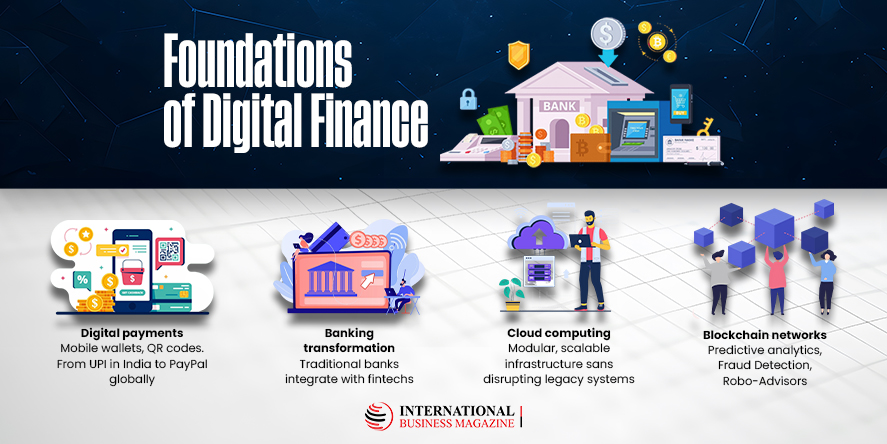
Foundations of Digital Finance
Digital payments: Mobile wallets, QR codes.
Banking transformation: Traditional banks integrate with fintechs.
Blockchain networks: Distributed ledgers ensure transparency and immutability.
Artificial Intelligence: AI powers fraud detection, robo-advisors, and predictive analytics. Cloud computing: Modular, scalable infrastructure sans disrupting legacy systems.
Core Components
Payment Infrastructure: Digital wallets, gateways, and Central Bank Digital Currencies.
Financial Service Providers: Banks, insurers, fintech startups, and neobanks.
Technology Platforms: APIs, mobile apps, and analytics dashboards.
Regulatory Frameworks: Consumer protection, anti-money laundering (AML), and cybersecurity laws.
Users: Individuals, enterprises, and governments – all interconnected in this digital marketplace.
.
Global Reach and Integration
Cross-border payments: Instant remittances via blockchain and SWIFT GPI.
Digital currencies: Bitcoin, Ethereum, and CBDCs.
Open banking: Customers securely share financial data with third-party apps.
Financial inclusion: Mobile banking in Africa and Asia brings millions into the formal economy.
.
Challenges and Risks
Cybersecurity threats: Hackers target wallets, exchanges, and APIs.
Regulatory gaps: Different jurisdictions impose varying rules on crypto and fintech.
Financial democratisation: Access to loans, investments, and insurance.
Sustainability linkages: Digital finance supports ESG tracking, green bonds, and climate finance.
.
Timeline of Banking Transformation
1950s: First Computer Banking System was created
1967: First ATM was introduced in London
1969: First American ATM opened at Chemical Bank in Rockville Centre, New York
1980s: Birth of “At-home Banking” Technologies
1990s: The World Wide Web boosts Digital Banking Push
2000-2019: Digital Banking Everywhere spreads
2020: COVID-19 Pandemic forces Digital Adoption
2026: Digital banking in full swing. Borderless banking round the clock
Article by Imtiaz Ahmad Sharif
For more articles on digital finance, please check:
The Lifestyle Benefits of Managing Personal Finances Through Digital Banking
The Finance future depends on evolution of Digital Tech trends