
Asset Integrity Management (AIM) is the quiet sentinel of modern industry. It ensures that the machinery powering global growth never falters, cross-continental pipelines remain secure, and offshore platforms withstand the relentless assault of wind and waves. Rather than a standalone process, AIM is a continuous strategy embedded in engineering and operations across every major sector.
What is Asset Integrity Management?
Asset Integrity Management (AIM) is a term used to describe the practice of managing an asset (power plant, oilrig, refinery, etc.) to ensure its ability to perform its function effectively and efficiently. Good AIM strategies ensure that the people, systems, processes and resources that enable an asset to deliver its function are in place over the life cycle of the asset, while simultaneously maintaining health and safety and environmental legislation.
Modern AIM programmes use established processes and cutting-edge technologies like preventive and predictive maintenance, Artificial Intelligence (AI) and the Internet of Things (IoT) to prevent assets from failing unexpectedly and causing downtime. AIM programmes help preserve asset functionality, safety and fitness-for-service (FFS) through proven maintenance strategies and regular risk-based inspection (RBI).
According to a recent report, the global market for AIM products and solutions was valued at $ 25 billion last year. It is likely to grow at a compound annual growth rate (CAGR) of almost 6% over the next 5 years.
Safety is first priority
Safety is the first pillar of Asset Integrity Management. Industrial assets are often immense, complex, and exposed to harsh environments. A pipeline stretching across deserts and rivers, a chemical plant brimming with volatile substances, or a towering offshore rig – all are potential sources of catastrophic risk if neglected. During the times of Geopolitical uncertainties and conflicts like one that unfolded in West Asia and Ukraine-Russia recently. Physical asset are vulnerable and demands safety of the highest standards. Safety in this context is not reactive; it is proactive. It begins with design, where engineers anticipate stresses, corrosion, fatigue mode, failure, and external dangers long before the first bolt is tightened and secured. It is not just about tightening a bolt, it is also about the security forces of a nation intercepts an incoming missile before damage is done.
Furthermore, it continues through construction, where quality assurance ensures that materials and workmanship meet exacting standards. In addition, it lives on in operation, where inspections, monitoring, and maintenance form a rhythm of care. Safety is the heartbeat of Asset Integrity Management, ensuring that every valve checked, every weld inspected, and every sensor calibrated, and every rivet is fixed.
.
Reliability, a necessity
Reliability is the second pillar, and it means continuity. An asset that fails unpredictably is a disruption that ripples through supply chains, economies, and lives. Reliability is achieved through systems that anticipate failure before it occurs. So, how it is done? By leveraging interconnected layers, such as condition monitoring, predictive analytics, and digital twins enabling, engineers, technicians and supervisors to resolve vulnerabilities before they disrupt operations.
Reliability is also cultural – it requires organisations to value consistency over shortcuts, to invest in training, and to empower teams to act when anomalies arise. In industries where downtime can cost millions per hour, reliability is not a luxury but a necessity, and Asset Integrity Management is the discipline that makes it possible.
.
Performance, a measure of delivery
Performance completes the triad, for safety and reliability alone are not enough. Assets must deliver value, and performance is the measure of that delivery. A refinery must not only avoid accidents and breakdowns; it must also operate at optimal efficiency, converting crude into products with minimal waste. A wind farm must not only stand tall against storms; it must also generate electricity at its designed and desired capacity. Performance is about maximising output without compromising safety or reliability, a delicate balance that requires continuous optimisation. Asset Integrity Management achieves this (performance) by integrating performance metrics into its framework, ensuring that every maintenance decision, every inspection schedule, and every upgrade contributes not just to survival but also to excellence.
.
Importance of Geography in AIM
The narrative of Asset Integrity Management is also geographic, stretching across diverse landscapes and industries. In oil and gas, it is the guardian of pipelines and rigs, preventing leaks that could devastate ecosystems. In power generation, it ensures turbines spin without interruption, feeding electricity into the grid that powers cities. In manufacturing, it keeps production lines running smoothly, avoiding costly stoppages. In aviation, it safeguards aircraft structures, ensuring that every flight is a testament to engineering precision. Across these domains, the principles remain constant: safety, reliability, performance. Yet the applications vary, adapting to the unique challenges of each sector and geography.
Technology has become the great enabler of this discipline. Sensors embedded in assets provide real-time data on temperature, pressure, vibration, and corrosion. Artificial Intelligence analyses these streams, detecting patterns invisible to human eyes. Drones and robotics extend the reach of inspectors into hazardous or inaccessible areas. Digital twins replicate assets in virtual space, allowing simulations of stress, wear, and failure. These innovations transform Asset Integrity Management from a reactive practice into a predictive science, where decisions are informed by foresight rather than hindsight. Technology does not replace human judgment but amplifies it, giving engineers and operators the tools to act with precision and confidence.
Asset Integrity Management thrives only in organisations that embrace it as a shared responsibility. It requires leadership that prioritises long-term resilience over short-term gains, workers who understand that every inspection matters, and regulators who enforce standards with rigor. Culture is the invisible framework that sustains safety, reliability, and performance, ensuring that the discipline is not just a checklist but also a way of thinking. When culture aligns with technology and process, Asset Integrity Management becomes a living system, resilient and adaptive.
Integrity is not an option, a necessity
Failures in asset integrity can lead to disasters that scar landscapes, harm communities, and erode trust. History offers sobering reminders of accidents born from neglected maintenance or ignored warnings. Each incident underscores the importance of vigilance, reminding industries that integrity is not optional but essential. Conversely, success stories abound where disciplined Asset Integrity Management has prevented crises, extended asset lifespans, and delivered consistent performance.
Conclusion
Asset Integrity Management is the unsung hero, the quiet force that ensures progress does not stumble. It is a discipline that marries engineering with ethics, technology with culture, foresight with responsibility. Safety, reliability, and performance are not abstract ideals but tangible outcomes achieved through relentless attention to detail. Thus, the story of Asset Integrity Management is one of vigilance and vision. It is a narrative without end, for assets must be cared for as long as they exist.
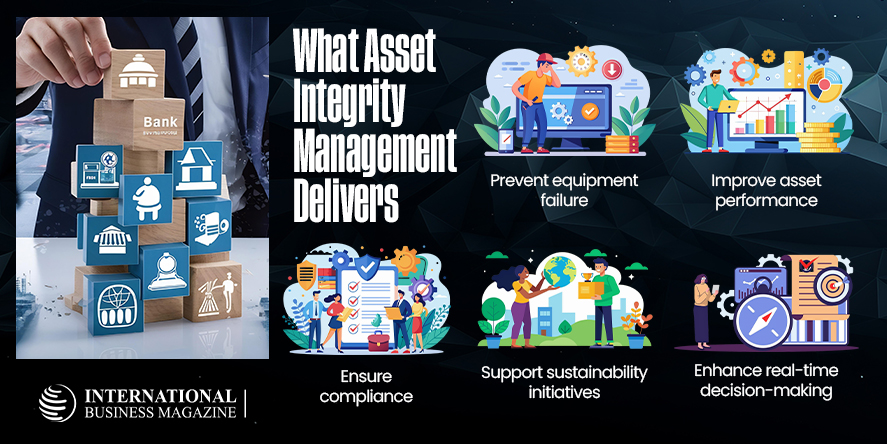
What Asset Integrity Management Delivers
- Prevent equipment failure
- Improve asset performance
- Ensure compliance
- Support sustainability initiatives
- Enhance real-time decision-making
.
Benefits
- Increased worker safety
- Stronger regulatory compliance
- Asset life extension
- Reduced downtime
- Stronger operational efficiency
Important Sectors
- Oil and Gas industry
- Healthcare
- Renewable Energy and
- Mining
- Oceaneering
- Automotive
- Manufacturing
- Insurance
- Aviation
- Food Processing
New Trends
1. AI- and ML-powered predictive analytics
2. Advancements in IoT sensor technology
3. Deeper cloud-based integration
Some Application areas
Power Sector: Boilers, turbines, head exchanges and pressure vessels.
Fertiliser Industry: Reactors, pipelines, storage tanks.
Chemicals and Petrochemicals: Stress corrosions, cracking. Fatigue and thinning
Environment risks.
Oil & Gas: Offshore and onshore pipelines, pressure systems and storage units.
Pharmaceutical Industry: Clear room environments, and high-precision machinery, FDA & GMP compliance via routine audits, mechanical integrity checks, and preventive maintenance planning.
Manufacturing: Preventive maintenance, equipment health monitoring and failure analysis to boost uptime and reducing operating costs.
Automobile Industry: Regular inspections, fatigue analysis and failure investigation.
Article By Imtiaz Ahmed Shariff