
For decades, the global financial sector relied on massive, on-site mainframe computers to manage ledgers, process transactions, and secure highly sensitive institutional data. While these monolithic legacy systems provided stability, they were inherently rigid, expensive to maintain, and notoriously difficult to upgrade. In the contemporary, digital economy, where agility and real-time processing are paramount, that historical infrastructure has become a critical bottleneck. The paradigm is now shifting fundamentally toward cloud banking technology. By migrating core operational architectures to remote, distributed servers, financial institutions are not merely upgrading their hardware; they are completely re-engineering how financial services are built, scaled, and delivered to the end user.
Dismantling Legacy Monoliths with Microservices
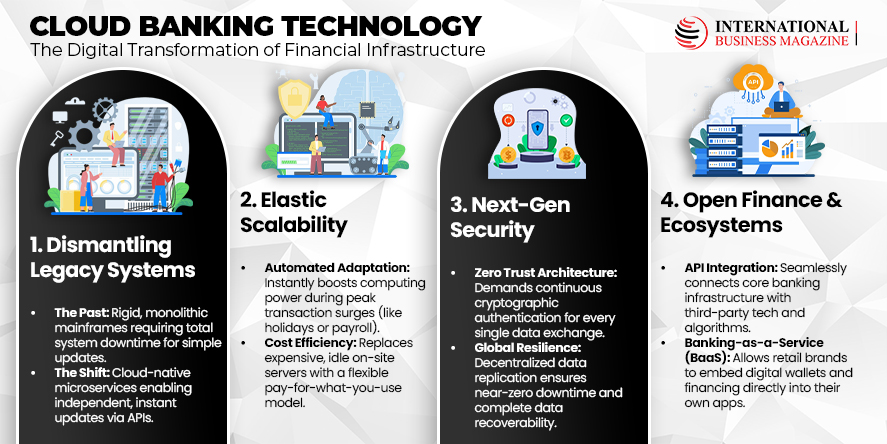
To fully comprehend the impact of cloud banking technology, it is essential to understand the architectural transition from monolithic software to microservices. In traditional core banking systems, all functionalities – from user authentication and transaction processing to loan origination and interest calculation – are woven into a single, massive codebase. Updating one specific feature requires taking the entire system offline, extensively testing the complete monolith, and risking widespread outages if a single line of code fails.
Cloud-native architecture completely dismantles these rigid structures. By utilizing containerization and microservices, cloud platforms break down complex banking operations into hundreds of small, independent applications that communicate seamlessly via application programming interfaces (APIs). As these microservices operate autonomously, developers can continuously update, deploy, or scale individual components without disrupting the wider financial ecosystem. If a new lending algorithm needs to be deployed, it can be seamlessly pushed to the live environment in minutes rather than months. This decoupling of services drastically accelerates the deployment timeline for new financial products, fostering an environment of continuous innovation.
Elastic Scalability and Operational Efficiency
One of the most profound technical advantages of cloud banking technology is its elastic scalability. Financial workloads are notoriously volatile. Transaction volumes can spike dramatically during end-of-month payroll processing, major retail holidays, or periods of extreme market volatility. Traditional on-premise infrastructure requires institutions to purchase and maintain excess server capacity simply to handle these rare peak loads – a highly inefficient capital expenditure.
Cloud infrastructure introduces automated elasticity. Advanced load-balancing algorithms continuously monitor network traffic and processing demands in real time, enabling resources to be distributed efficiently as demand fluctuates. When a sudden surge in transaction volume occurs, the cloud environment automatically provisions additional computing power and memory to absorb the load seamlessly, preventing system crashes and ensuring uninterrupted service. Once the demand subsides, the system scales down autonomously. This transitions financial institutions from a rigid, capital-intensive model to a highly efficient, consumption-based operational expense model, where they pay strictly for the computational resources they actively utilize.
Redefining Cybersecurity and Regulatory Compliance
Historically, the primarily hesitation surrounding cloud banking migration was the perception of compromised security. The notion of moving highly confidential financial data off-site was viewed as a critical vulnerability. However, modern hyperscale cloud infrastructure has proven to be exponentially more secure than the majority of aging, on-premise data centres.
Cloud banking technology operates on a foundational principle of zero trust architecture. In this security model, no user, device, or network request is implicitly trusted, regardless of whether it originates from inside or outside the organizational perimeter. Every single data exchange is subjected to rigorous, continuous cryptographic authentication. Furthermore, cloud environments employ advanced encryption protocol–securing data both in transit and at rest–alongside automated threat detection systems powered by artificial intelligence.
From a compliance perspective, cloud architectures offer unparalleled resilience. Financial data is not stored on a single physical server; it is continuously replicated and sharded across multiple isolated data centres globally. If a localized hardware failure or a targeted cyberattack occurs, the system automatically routes operations to an unaffected node, ensuring near-zero downtime and guaranteeing that institutional data remains fully recoverable, perfectly aligning with rigorous international financial regulations.
Catalyzing Open Finance and BaaS Ecosystems
Beyond internal operational efficiency, cloud technology is the primary technological enabler of Open Banking and Banking-as-a-Service (BaaS) models. Because cloud architectures are inherently API-driven, they allow financial institutions to securely open their core infrastructure to third-party developers and external technology firms.
This interoperability allows for the seamless integration of external services, such as specialized wealth management algorithms, localized payment gateways, or alternative credit scoring models, directly into a bank’s primary interface. Conversely, it allows retail brands or e-commerce platforms to embed financial products–like digital wallets or point-of-sale financing products–directly into their own applications, utilizing the bank’s underlying cloud infrastructure to process the transactions.
Conclusion
The transition to cloud banking marks a lasting evolution in the financial industry, reshaping how institutions deliver services and manage operations. The reliance on inflexible, hardware-bound mainframes is rapidly becoming obsolete in an era defined by decentralized computing and instantaneous data transfer. By embracing cloud-native architectures, financial institutions are achieving unprecedented levels of operational agility, elastic scalability, and cryptographic security. Ultimately, this technological transformation is not just about reducing server costs or modernizing legacy code; it is about building a resilient, adaptable foundation capable of powering the next generation of global digital finance.
Blog by Charan M.S