
The modern digital economy operates on an endless current of data. For years, organizations have collected immense volumes of information, utilizing traditional analytics to understand what happened in the past and why it occurred. However, this retrospective approach is no longer sufficient. The advent of artificial intelligence has catalysed a monumental shift in how data is utilized, transitioning the focus from historical reporting to future forecasting. This evolution is driven by AI analytics – a sophisticated framework that transforms raw, unstructured data into predictive intelligence. By leveraging advanced machine learning algorithms and deep neural networks, systems can now anticipate future outcomes, enabling a proactive approach to strategy and operations that was previously unattainable.
Beyond Descriptive Analytics
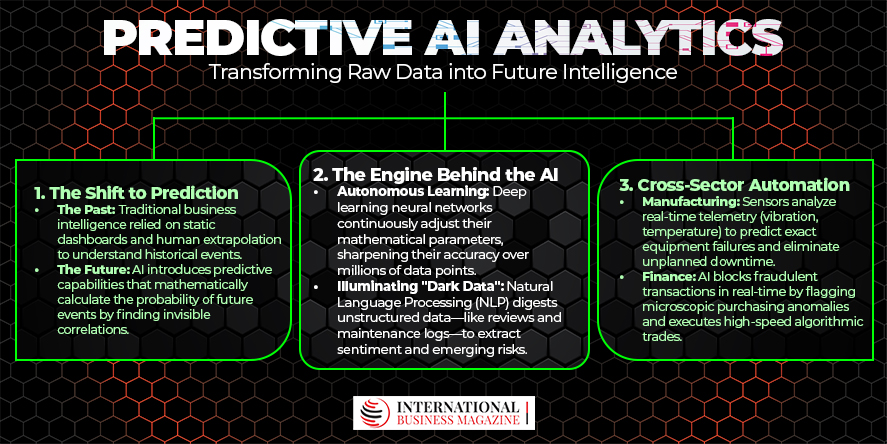
To grasp the magnitude of this shift, one must understand the limitations of conventional data analysis. Traditional business intelligence relies primarily on descriptive and diagnostic analytics, which organize historical data into static dashboards and reports. While useful for identifying past trends, these tools require human analysts to interpret the data and manually extrapolate future trajectories.
AI analytics fundamentally disrupts this paradigm by introducing predictive and prescriptive capabilities. Predictive intelligence does not merely present a picture of the past; it mathematically calculates the probability of future events. By ingesting massive datasets – ranging from consumer behaviour patterns to global supply chain fluctuations – AI models identify subtle, complex correlations that are entirely invisible to the human eye. This allows systems to forecast demand, predict equipment failures, and anticipate market shifts with remarkable accuracy, operating continuously and without fatigue.
The Underlying Mechanics of Prediction
The engine powering this predictive capability is machine learning, specifically deep learning neural networks. Unlike traditional software programming, which relies on rigid, rule-based logic manually coded by engineers, machine learning algorithms autonomously learn and adapt autonomously. When fed historical data, these models adjust their internal mathematical parameters to minimize the difference between their predictions and actual historical outcomes. Over time, as they process millions of data points, their predictive accuracy sharpens exponentially.
Furthermore, the integration of natural language processing (NLP) allows AI analytics platforms to digest unstructured data – such as text from customer reviews, financial reports, or maintenance logs. Previously, this unstructured information was considered “dark data,” largely unusable by standard analytics tools because it lacked a rigid database structure. Today, AI can extract sentiment, identify emerging risks, and factor these abstract variables into its predictive models, creating a truly holistic view of the operational landscape.
Cross-Sector Applications and Automation
The implementation of predictive intelligence is completely reshaping operational frameworks across multiple sectors. In the manufacturing sector, AI analytics powers predictive maintenance. Rather than servicing machinery on a fixed calendar schedule or waiting for a catastrophic breakdown, sensors continuously monitor equipment vibration, temperature, and acoustic signatures. AI algorithms analyse this real-time telemetry against historical failure data to predict exactly when a specific component will fail. This facilitates targeted maintenance that eliminates costly unplanned downtime and extends the lifespan of industrial hardware.
In the financial sector, predictive intelligence is revolutionizing risk management and fraud detection. By analysing transaction velocities, geographical data, and microscopic purchasing anomalies in real time, AI can flag and block fraudulent transactions before they are authorized. Similarly, algorithmic trading models utilize predictive analytics to forecast market movements based on complex economic indicators, executing trades at speeds that capitalize on fleeting market inefficiencies.
The Imperative of Data Integrity
Despite the extraordinary capabilities of AI analytics, the underlying mathematics remain bound by a foundational principle of computer science: garbage in, garbage out. A predictive model is only as intelligent as the data it is trained upon. If historical data is incomplete, fragmented across isolated servers, or riddled with inaccuracies, the resulting AI predictions will be fundamentally flawed.
Therefore, the successful deployment of predictive intelligence requires a rigorous commitment to data hygiene and modern data architecture. Organizations must dismantle fragmented data silos and establish unified data lakes where information is standardized, continuously cleaned, and made easily accessible to machine learning pipelines.
Moreover, developers must remain hyper-vigilant against algorithmic bias. If the historical data used to train an AI model contains inherent prejudices or skewed demographics, the predictive intelligence will inevitably amplify those biases, leading to skewed outcomes and systemic failures. Ensuring mathematical transparency and conducting continuous auditing of AI models is absolutely essential to maintain the integrity and fairness of the predictive outputs.
Conclusion
The transition from raw data to predictive intelligence represents one of the most significant technological leaps of the twenty-first century. As computing power continues to scale and machine learning algorithms become increasingly sophisticated, the accuracy and scope of AI analytics will only expand. The entities that thrive in this new era will be those that view data not merely as a static record of the past, but as a dynamic, strategic asset for illuminating the future. By fully embracing predictive intelligence, it is possible to move decisively beyond the limitations of reactive decision-making. Ultimately, AI analytics provides the ultimate competitive advantage: the unprecedented ability to know what is coming next, and the actionable insight required to meet it head-on.
Blog written by Charan M.S