
The landscape of global trade has undergone a fundamental restructuring. Historically, commerce was defined by a strictly linear, transactional model: a manufacturer designs a product, a retailer stocks it, and a consumer purchases it. Today, that linear chain has evolved into a complex, multidimensional ecosystem. Modern commerce is no longer just about the exchange of capital for physical or digital goods; it is about the continuous, algorithmic synthesis of customer experience, underlying digital infrastructure, and sustainable economic expansion. In this contemporary framework, technology is not merely a supporting operational function but is the very connective tissue that binds market demand to enterprise scalability.
Headless Architecture and the Omnichannel Reality
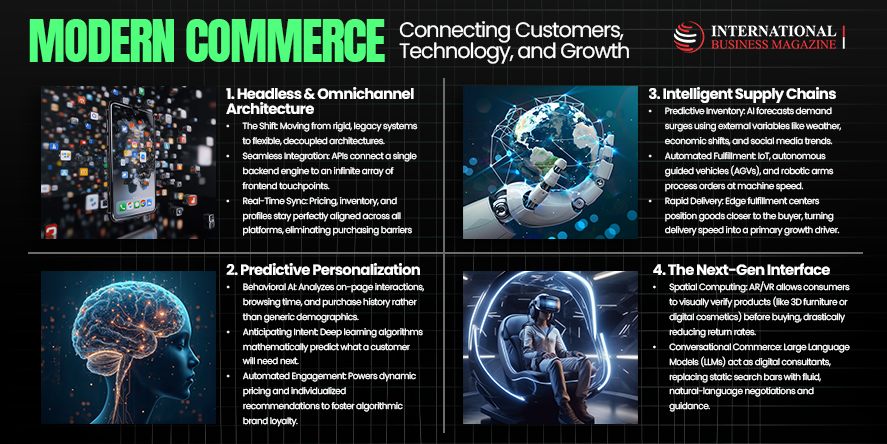
For years, enterprises operated on monolithic digital platforms where the frontend user interface and the backend database were tightly coupled. This created rigid environments where launching a new digital storefront or integrating a novel payment gateway required months of hazardous software development. The modern commerce solution to this technological bottleneck is decoupled architecture. By separating the frontend presentation layer from the backend commerce engine, organizations can utilize Application Programming Interfaces (APIs) to push products and content seamlessly across an infinite array of touchpoints.
This architectural shift is the technical foundation of true omnichannel commerce. A consumer might discover a product via an interactive social media application, configure its specific dimensions on a mobile web browser, and seamlessly finalize the transaction through a voice-activated smart device. This infrastructure ensures that pricing, inventory levels, and customer profile data remain perfectly synchronized across all these distinct digital interfaces in real time. This frictionless interconnectivity eliminates purchasing barriers, directly accelerating revenue growth by meeting consumers precisely where they choose to interact.
Algorithmic Personalization and Predictive Engagement
Customer expectations have matured far beyond generic digital storefronts. The modern consumer demands hyper-personalized interactions, and delivering this at scale requires sophisticated data orchestration. This is where artificial intelligence and machine learning intersect with commercial growth. Instead of making decisions based on broad demographic assumptions, advanced commerce platforms evaluate rich behavioural data, including on-page interactions, time spent browsing, and customers’ purchasing history, to deliver more relevant experiences.
Through the application of deep learning algorithms, this raw, unstructured data is transformed into predictive intelligence. The system does not just react to what a customer is currently searching for; it mathematically calculates the probability of what they will need next. This enables dynamic pricing models, individualized product recommendations, and automated, context-aware marketing triggers. By anticipating consumer intent with high statistical precision, enterprises drastically improve conversion rates, minimize customer acquisition costs, and foster deep, algorithmic brand loyalty.
Supply Chain Automation and Algorithmic Fulfilment
The frontend customer experience is completely dependent on backend operational efficiency. Modern commerce dictates that the supply chain can no longer be a reactive, manual entity; it must operate as a proactive, intelligent network. The combination of Internet of Things (IoT) technology and autonomous robotics is transforming the way fulfilment centres operate around the world.
Inventory management is now governed by predictive analytics rather than manual auditing. AI models analyze complex external variables—such as localized economic shifts, seasonal weather patterns, and real-time social media trends—to forecast demand surges before they occur. As a result, the system automatically positions inventory at edge fulfilment centres closest to areas where demand is expected, helping businesses respond faster to customer needs. Within these highly automated facilities, autonomous guided vehicles (AGVs) and robotic picking arms operate in algorithmic synchronization to process orders at machine speed. This technological density dramatically compresses the timeline between digital checkout and physical delivery, converting fulfilment speed into a primary driver of commercial growth and customer retention.
Spatial Computing and the Next Interface
As the underlying infrastructure of commerce matures, the interface through which customers interact with digital markets is also taking a new shape. The integration of spatial computing, including augmented reality (AR) and virtual reality (VR), is bridging the tactile gap between the physical and digital worlds. Advanced AR protocols allow consumers to project high-fidelity, three-dimensional models of furniture into their living spaces or overlay digital cosmetics onto their faces via mobile lenses in real time before making a purchase. This visual verification significantly reduces return rates and boosts buyer confidence.
Simultaneously, conversational commerce is being elevated by large language models (LLMs). Customer service and product discovery are transitioning from static search bars to fluid, natural-language dialogues with autonomous digital agents. Designed to interact much like skilled consultants, these AI systems can negotiate, offer informed guidance, and recommend relevant products or services. As a result, companies can extend personalized control experiences to a massive audience while keeping costs under control.
Conclusion
The architecture of modern commerce represents a seamless convergence of human desire and computational power. By dismantling rigid legacy systems in favor of flexible, modular architectures, enterprises can adapt to shifting consumer behaviours instantly. AI helps businesses deliver highly relevant digital experiences, while automated supply chains ensure those expectations are met through fast and efficient real-world fulfilment. Ultimately, in this new digital economy, growth is not achieved through aggressive market expansion alone; it is engineered by utilizing advanced technology to forge frictionless, highly intelligent connections between the product and the customer.
Article written by Charan M.S




























































![Alstom, a global leader in smart and sustainable mobility, has signed a €22 million[1], five-year contract with Saudi Arabia Railways (SAR) to support the reliability and day-to-day performance of its North Freight fleet operating along the Kingdom’s North–South corridor. Image courtesy: Alstom](https://intlbm.com/wp-content/uploads/2026/09/Alstom-and-Saudi-Arabia-Railways-deepen-long-term-partnership-to-enhance-freight-rail-performance-across-the-Kingdom.Image-Courtesy-Alstom.png)