
Parenting is evolving through technology, with high-tech babywear emerging at the intersection of fashion, healthcare, and smart caregiving. While parents traditionally relied on instinct, modern wearable innovation now provides unprecedented insights into an infant’s well-being. This shift enhances child comfort, safety, and convenience, offering parents greater peace of mind.
Smart clothing emerged around 2015, making it a relatively new innovation. The brilliance of this technology lies in its ability to merge everyday apparel with advanced biometric sensors to seamlessly monitor vital signs like heart rate, body temperature, and breathing patterns.
Modern parenting leverages high-tech babywear to monitor and care for infants effectively. By integrating intelligent sensors and connected technology into everyday garments, these advanced clothes track real-time health and environmental data. This innovation transforms simple clothing into an active, sophisticated tool, revolutionising childcare in a fast-paced world. One of the most significant advancements in high-tech babywear is the integration of biometric monitoring capabilities.
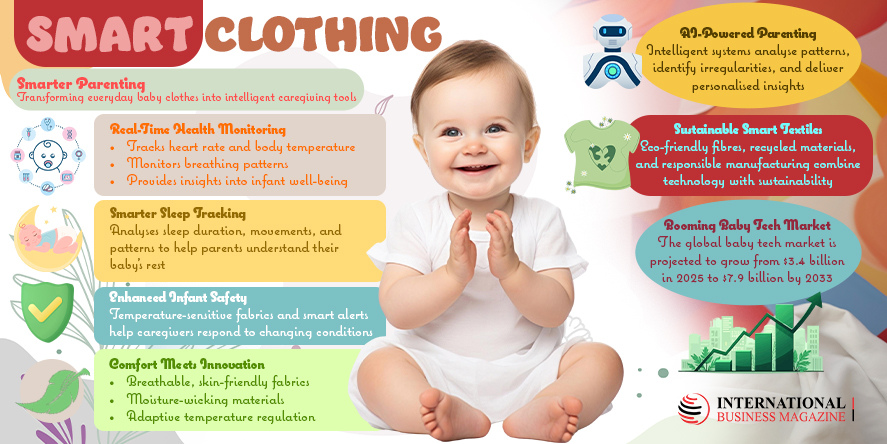
Smart baby clothing can now track essential health indicators such as body temperature, heart rate, respiratory patterns, and sleep quality. Embedded textile sensors continuously gather data without causing discomfort or interfering with a baby’s natural movements. This information is transmitted wirelessly to mobile applications, enabling parents to monitor their child’s condition from virtually anywhere. Such innovations are particularly valuable for first-time parents who often experience anxiety about their baby’s wellness and safety. By providing real-time insights and alerts, these garments help reduce uncertainty and offer greater peace of mind.
Baby monitoring technology includes movement monitors (such as under-mattress mat monitors that trigger an alarm after 15 to 20 seconds of no movement), health vitals monitors, and audio-video monitors used to observe infants without tracking vital signs.
Sleep monitoring has become another transformative feature within the smart babywear ecosystem. Advanced sleep-tracking garments can analyse duration, movement, breathing rhythms, and sleep cycles. Through intelligent data analysis, parents gain a clearer understanding of what affects their child’s rest and can make informed adjustments to routines and environments.
Enhancing Infant Protection
Safety remains one of the strongest drivers behind the development of smart baby clothing. Manufacturers are increasingly incorporating features designed to enhance infant protection in everyday settings. Temperature-sensitive fabrics can notify caregivers if a baby becomes too hot or too cold, reducing the risk of discomfort and heat-related complications.
Beyond healthcare monitoring, innovations in fabric technology are redefining comfort and functionality. Traditional baby clothing often struggles to address challenges such as moisture management, skin sensitivity, and temperature regulation. Smart textiles are designed to adapt to environmental conditions, helping maintain optimal comfort throughout the day. Moisture-wicking fabrics keep babies dry, while breathable materials improve airflow and reduce irritation.
What is interesting is that modern parents are becoming more conscious of environmental responsibility and are seeking products that align with their values. In response, manufacturers are developing eco-friendly smart textiles that combine technology with sustainable production practices. Organic fibres, recycled materials, biodegradable components, and environmentally responsible manufacturing methods are helping create baby garments that are both intelligent and environmentally conscious.
Artificial intelligence is further enhancing the capabilities of smart baby clothing. By analysing patterns collected over time, AI-powered platforms generate personalised insights tailored to each infant’s unique needs. Instead of simply presenting raw data, these systems identify trends, recognise irregularities, and provide recommendations that help parents make informed decisions.
Market Growth Potential
The global baby apparel and Smart babywear market is expanding due to rising disposable incomes, changing lifestyles, and high demand for branded clothing. Key drivers include aggressive social media marketing and widespread availability across online and offline channels. Additionally, physical store expansions are significantly fuelling product demand.
According to a report by Mordor Intelligence, sustained global birth rate has enabled a steady influx of new consumers for the babywear market. According to the United Nations’ World Fertility 2024 report, approximately 132 million infants were born globally, driving consistent annual demand. This continuous demographic growth, paired with frequent outgrowing of sizes, secures stable long-term market expansion for Babywear.
Valued at USD 3.4 billion in 2025, the global baby tech market is projected to reach USD 7.9 billion by 2033, expanding at an 11.20% CAGR. The growth is propelled by heightened safety awareness, smart home integration, and dual-income households prioritising convenient childcare, says Grandview Research in an analysis.
Despite its many advantages, the rise of high-tech babywear also raises important considerations regarding privacy, data security, and accessibility. The collection of health-related information necessitates strong safeguards to protect sensitive personal data.
Furthermore, advances in nanotechnology, flexible electronics, smart fibres, and artificial intelligence are expected to create garments that are even more intelligent, lightweight, and responsive. Future baby clothing may be capable of detecting early signs of illness, adapting automatically to changing environmental conditions, and integrating seamlessly into broader smart-home ecosystems. The evolution of high-tech babywear embodies the essence of modern parenting: combining love, care, and vigilance with the power of innovation. In an era where technology increasingly shapes daily life, smart baby clothing offers a practical way to enhance infant care without compromising comfort or emotional connection.
By transforming ordinary garments into intelligent tools for health monitoring, safety, and well-being, high-tech babywear is redefining how families nurture the next generation. Smart parenting is no longer solely about responding to a baby’s needs; it is increasingly about understanding those needs in real time, and smarter clothes are the game changers.
Article by Imtiaz Ahmed Shariff