
Across the Americas, Asia, and Europe, digital grocery platforms are rapidly reshaping the way consumers shop for everyday essentials, driven by convenience, speed, and evolving lifestyles.
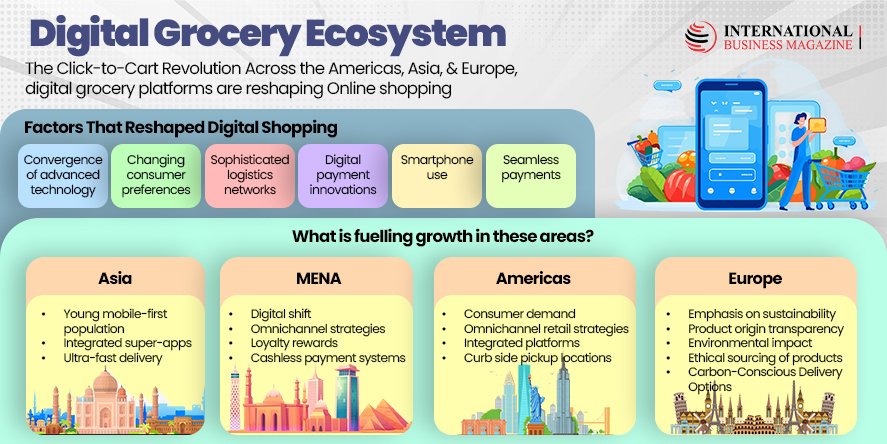
The digital grocery ecosystem has evolved from a convenience-oriented retail channel into one of the most dynamic components of the global digital economy. Across the Americas, Asia, and Europe, the convergence of advanced technology, changing consumer preferences, sophisticated logistics networks, and digital payment innovations has transformed the way people shop for food and household essentials.
What began as a niche service for urban consumers has rapidly matured into an interconnected ecosystem involving retailers, delivery providers, technology firms, payment platforms, data analytics companies, manufacturers, and consumers. Today, digital grocery shopping has emerged as a mainstream purchasing virtual market place. Driven by rising smartphone use, seamless payments, and a demand for convenience, digital grocery ecosystems are transforming global retail into a connected, data-driven experience.
Asia’s Mobile First Consumers Boost Growth
Asia leads the global digital grocery ecosystem, driven by a young, mobile-first population and integrated super-apps combining shopping, payments, and delivery. In East and Southeast Asia, nations like China, India, South Korea and Indonesia serve as hubs for rapid innovation, offering ultra-fast delivery. According to the Google, Bain & Company, and Temasek e-Conomy SEA 2026 report, Southeast Asia’s digital sales are projected to grow 17 per cent to 368 billion dollars in 2026.
West Asian markets like the UAE, Saudi Arabia, and Kuwait are experiencing a similar surge. Redseer research highlights that the MENA online grocery sector is expanding three times faster than traditional retail, boasting a projected 28 per cent Compound Annual Growth Rate across the UAE, Saudi Arabia, and Egypt. This digital shift has forced traditional retailers to adopt omnichannel strategies. Supported by cashless payment systems, personalised experiences, and loyalty rewards, app-based grocery shopping has seamlessly embedded itself into the daily routines of Asian consumers, cementing its place as a vital pillar of the region’s modern retail landscape and broader digital economy.
In essence, the Asian region’s young, tech-savvy population increasingly prefers app-based grocery shopping, encouraging traditional retailers to embrace omnichannel strategies. As a result, digital grocery services are becoming an integral component of Asia’s modern retail landscape and broader digital economy.
The Americas’ Omnichannel Food Rush
In the Americas, digital grocery adoption has accelerated through a combination of consumer demand for convenience and substantial investment in omnichannel retail strategies. Large supermarket chains, warehouse clubs, and online marketplaces have built integrated platforms that allow customers to browse products online, compare prices, schedule deliveries, or collect purchases from curb side pickup locations.
The North American market, in particular, has witnessed strong growth in same-day and even one-hour grocery delivery models, supported by advanced logistics and widespread smartphone usage. Consumers increasingly appreciate the ability to manage recurring grocery needs through subscriptions, personalised recommendations, and automated shopping lists generated through artificial intelligence. In Latin America, rapid urbanisation and expanding internet access have created fertile ground for digital grocery expansion.
Europe’s Carbon-Conscious Delivery Options
Across Europe, the digital grocery ecosystem is evolving with a strong emphasis on sustainability, efficiency, and customer experience. European consumers increasingly value transparency regarding product origins, environmental impact, and ethical sourcing practices. As a result, digital grocery platforms often integrate information about sustainability credentials, local sourcing, and carbon-conscious delivery options. A research report published in Anthropocene Magazine mentions that grocery delivery reduces carbon emissions through consolidated, efficient routing, much like individuals halving their footprint by combining store stops with daily commutes. For tech alternatives, sidewalk robots are the most carbon-efficient method for households within two miles, while drones excel at delivering single items over traditional car trips.
Retailers in this region are leveraging digital channels not only to increase convenience but also to deepen customer relationships through personalised marketing, targeted promotions, and subscription-based shopping programmes that simplify household management. Europe’s mature digital infrastructure and robust regulatory environment provide a stable foundation for continued innovation in online grocery retail.
How Digital Grocery Took Shape
Clarence Saunders in the US pioneered today’s eCommerce foundations in 1916 by opening Piggly Wiggly, the first self-service grocery store. Rather than relying on clerks to gather items from a list, customers independently selected products themselves. This revolutionary shift laid the groundwork for the user-driven digital shopping experiences we use today. The 2020 pandemic highlighted the need for online grocery shopping, driving a massive surge in consumer adoption. According to US-based EMarketer, Grocery AI adoption in the US is surging, with 92% of retailers leveraging technology for personalisation. Shoppers increasingly embrace AI for automated restocking (32.6%), meal planning chatbots (45.8%), and tailored promotions (51%).
According to Kerney 100, a management consulting firm, India’s retail market is rapidly transforming through digital growth and the rise of quick commerce, which delivers goods in minutes. While traditional stores offer 2% to 5% discounts and quick commerce provides 6% to 9%, standard e-commerce leads with the steepest price cuts at 13% to 18%.
Mr Neel Arora, Global Head of eCommerce @ Nestlé, in his LinkedIn post stated that the last mile delivery and quick commerce originated in China through restaurant and grocery services. The COVID-19 pandemic accelerated market growth, sparking rapid deliveries, startups, and acquisitions.
At the heart of the digital grocery ecosystem lies a sophisticated technology infrastructure that connects multiple stakeholders in real time. Artificial Intelligence and machine learning have become essential tools for understanding customer preferences, forecasting demand, optimising pricing strategies, and managing supply chains. Retailers use predictive analytics to anticipate shopping behaviour, ensure product availability, and minimise food waste. Recommendation engines suggest relevant products based on previous purchases, while dynamic pricing systems enable retailers to respond quickly to changing market conditions. These technologies improve operational efficiency while creating highly personalised shopping experiences that enhance customer satisfaction.
Logistics and fulfilment networks represent another crucial pillar of the ecosystem. Fast and reliable delivery has become a key competitive differentiator, prompting retailers. The development of dark stores, micro-fulfillment centres, and hyperlocal distribution hubs enables companies to position inventory closer to consumers, reducing delivery times and operational costs.
Furthermore, Digital payments have also played a central role in driving the growth of online grocery ecosystems. Secure payment gateways, digital wallets, mobile banking applications, and contactless payment technologies have reduced friction in the purchasing process and increased consumer confidence. The integration of loyalty programmes, rewards systems, and personalised discounts within payment platforms further encourages digital engagement.
The grocery ecosystem also benefits manufacturers and suppliers, who gain valuable insights into consumer behaviour through digital channels. Detailed purchasing data allows brands to identify emerging trends, evaluate product performance, and develop targeted marketing campaigns. Real-time feedback mechanisms provide immediate visibility into customer preferences, enabling faster product innovation and more responsive inventory management.
Consumer expectations continue to shape the evolution of digital grocery ecosystems. Modern shoppers increasingly seek convenience, speed, product variety, and personalised experiences. They expect intuitive mobile applications, transparent pricing, flexible delivery options, and real-time updates throughout the purchasing journey.
The future of digital grocery retail will be defined by deeper integration of emerging technologies. Artificial Intelligence, robotics, autonomous delivery systems, Internet of Things devices, voice commerce, and predictive shopping assistants are expected to further transform the customer experience. As these innovations become mainstream, the boundaries between physical and digital retail will continue to blur, creating a seamless and highly personalised grocery ecosystem.
Article by Imtiaz Ahmed Shariff