
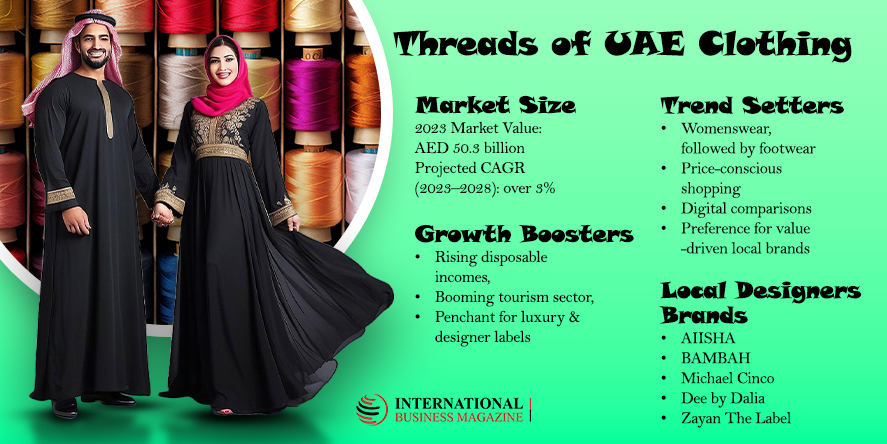
The United Arab Emirates has long been considered as a hub of commerce, luxury, and innovation. Yet beyond its glittering malls and cosmopolitan skyline lies a story stitched together by fabric, thread, and ambition – the story of its apparel and ready‑made garments sector. Valued at AED 50.3 billion in 2023, this industry is not merely about clothing; it is about UAE’s ability to transform local brands into global clothing ambassadors.
The sector’s growth, projected at a steady 3% CAGR through 2028, reflects rising disposable incomes, tourism‑driven demand (Geopolitical tensions in early 2026 acted as a stumbling block) and the rapid adoption of e‑commerce. But what makes the UAE’s apparel narrative unique is the dominance of home-grown brands – enterprises that began in Dubai or Sharjah and now spread across continents, competing with international giants while retaining a distinctly regional voice.
A report by 6Wresearch suggests that the UAE market’s growth is amplified by a combination of factors which include rising disposable incomes, a booming tourism sector (The unresolved US, Israel conflict with Iran has slowed the tourist inflow), and a penchant for luxury and designer labels.
A Ken Research report projects the future outlook of the UAE apparel sector to grow at 6% CAGR, reaching $20 billion by 2030.
The local biggies
Max Fashion: Everyday Style, Everywhere
At the heart of this story is Max Fashion, Landmark Group’s flagship brand. Established in 2004, Max has become synonymous with affordable fashion for middle‑income families. With over 500 stores across MENA, India, and Southeast Asia, Max is by any standards the UAE’s most globalised apparel name. Its offerings span ready‑to‑wear clothing, footwear, and accessories, balancing affordability with trend‑driven design.
Max’s success lies in its ability to democratise fashion. In a region where luxury often dominates the fashion scene, Max provides everyday style for millions, asserting that accessibility can coexist with aspiration. Its expansion into India and North Africa signifies the UAE’s role as a retail exporter, transforming Dubai’s malls into launch pads for global outreach.
Splash: Bold Boss in Fashion
If Max is the everyday wardrobe, Splash is the bold statement. Founded in 1993, Splash has carved a niche with bold campaigns, sustainability initiatives, and collections that mirror global trends while retaining regional flair. With operations in over 10 countries, Splash is more than a retailer; it is a cultural ambassador, exporting UAE creativity to markets as diverse as Pakistan and Saudi Arabia.
Splash’s campaigns often bypass norms, positioning the brand as a voice of inclusivity and modernity. Its emphasis on eco‑friendly fabrics and recycling initiatives reflects a growing sustainability trend in the UAE’s apparel sector.
Redtag: Family Lifestyle at Scale
For families across the GCC, Redtag has become a household name. Positioned as a family lifestyle brand, Redtag promotes affordability, convenience, and accessibility. Its stores are strategically located in community malls and high‑footfall areas, making it a must destination for everyday shopping.
Redtag’s strength lies in its ability to cater to diverse demographics – from children’s wear to adult fashion, all under one roof. Its aggressive expansion across GCC markets underscores the UAE’s ability to scale local concepts regionally, reinforcing Dubai’s reputation as a retail incubator.
Babyshop: Childhood Wardrobes
No narrative of UAE apparel is complete without Babyshop. Established in 1973, Babyshop has nurtured generations of families, offering children’s apparel, toys, and accessories. Its presence across the GCC makes it integral to family shopping culture, embedding itself into the UAE’s social fabric.
Babyshop’s longevity is a testament to the UAE’s ability to build brands that endure. While global children’s wear giants compete for market share, Babyshop retains loyalty through trust, affordability, and cultural resonance.
The Global Footprints
Local apparel brands are no longer confined to the Gulf. Max Fashion operates in India, North Africa, and Southeast Asia, making it one of the UAE’s most globalised retail names. According to 6Wresearch in 2028 USA is likely to be most attractive market followed by Saudi Arabia and the Netherlands for local brands.
Splash exports UAE’s fashion sensibility to markets in Pakistan, Saudi Arabia, and beyond.
Redtag has expanded aggressively across GCC, positioning itself as a pan-regional player. Their global outreach reflects the UAE’s ambition to be a fashion hub, leveraging Dubai’s retail infrastructure and Sharjah’s manufacturing base.
Tourism also plays a pivotal role, with Dubai’s malls serving as fashion destinations for visitors from Asia, Europe, and Africa. E‑commerce adoption has accelerated post‑pandemic, with local brands investing heavily in digital storefronts and Omni channel strategies. Today, the UAE has transformed as a hotbed for cutting-edge fashion. Some of the prominent local designer brands are:
AIISHA: Top clothing brands for women promoted by designer Aiisha Ramdan offers formal, casual, and bridal wear.
Michael Cinco: A women’s fashion label established by Filipino designer Michael Cinco, whose creations have been worn by stars such as Jennifer Lopez, Beyoncé, Lady Gaga, and Rihanna.
BAMBAH- BAMBAH: Deals in contemporary outfits in the luxury segment. The brand specializes in a variety of apparel, including gowns, dresses, pants, tops, and skirts.
Dee by Dalia: Designer Dalia El Ali’s brain child is a top local clothing brand. It offers quirky and innovative 60s and 70s-themed designs. The brand’s collections include Autumn, Sirius, and the Summer collection.
Zayan The Label: Dubai-based fashion designer Zayan Ghandour. Known for vibrant collections featuring hand-embroidered patterns and prints.
Other reputed brands include Nafsika Skourti, The Fierce Nay, Saucelovers, Nathalie Trad, Sass The Boutique, L’Afshar, Shorouk, Original Marakkeh, and more.
Blog by Imtiaz Ahmed Sharif