
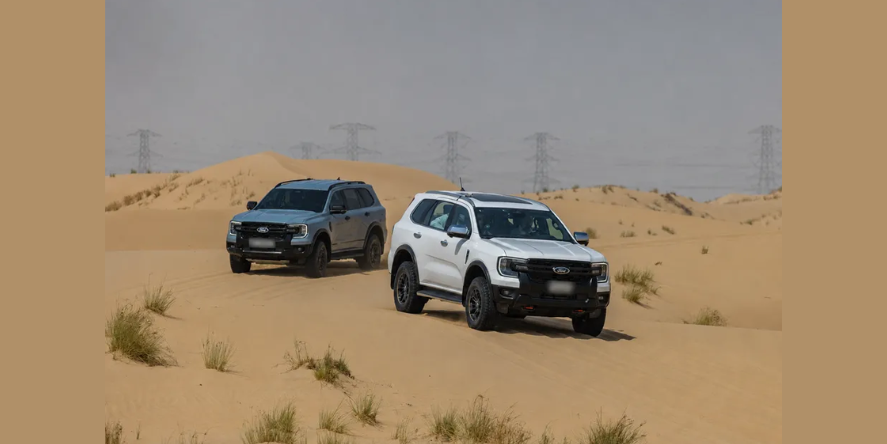
From high temperatures and direct sunlight to desert sand, mountain roads and long-distance travel, driving conditions across the Middle East place unique demands on vehicles.
Ford evaluates vehicles in these conditions through regional product development work led by its Dubai-based team. Working alongside Ford’s global Product Development organization, the team brings local insight, customer feedback and in-market testing into the vehicle-development process.
This approach supports Ford’s focus on understanding how vehicles perform in the environments where customers live and drive — from city traffic and highways to dunes, wadis and off-road trails.
Ravi Ravichandran, President, Ford Middle East and North Africa, said: “Middle East customers expect capability, power, confidence and durability from their vehicles. Testing in the region helps Ford engineers assess vehicle performance in conditions that reflect how many customers use their vehicles. It’s an important part of how we apply local insight to help meet customer needs.”
Regional testing in demanding conditions
Ford’s regional product development work evaluates how vehicle systems and materials respond to the conditions found across the Middle East. This includes:
- Cooling and cabin comfort: Engineers evaluate cooling-system performance, powertrain temperatures and air-conditioning operation in high ambient temperatures and under demanding driving conditions.
- Materials and durability: Interior and exterior materials, including trim, upholstery and seals, are assessed in high heat, UV exposure and dusty conditions.
- Sand, dust and terrain: Vehicles are evaluated across desert sand, rocky tracks, wadis and mountain roads to assess sealing, suspension, drivetrain performance and overall vehicle behavior.
- Electrified vehicle readiness: For electrified vehicles, regional testing includes battery thermal management and charging performance in extreme heat.
Regional testing complements Ford’s laboratory and global engineering work. It allows engineers to understand how local climate, surfaces, and driving patterns can affect vehicle systems and helps inform product decisions for the Middle East.
Preparing for the Everest V6
Ford’s regional approach will be reflected in the arrival of the 2026 Ford Everest V6, which is scheduled to join the Middle East line-up in November 2026.
The Ford Everest V6 expands the line-up with a 2.7-litre V6 EcoBoost engine that produces 310 horsepower and 500 Nm of torque and is paired with a 10-speed automatic transmission.
The 2026 Everest range includes Active, Sport, Platinum and the all-new Tremor variants, offering customers with a wider choice of vehicles designed for everyday driving, family travel and off-road use.
The Everest V6 reflects Ford’s commitment to testing for the region, in the region — combining global engineering expertise with local evaluation to help meet the needs of Middle East customers.
The next layer: Ford’s MENA In-Market Voice of Customer Fleet Validation Program
Ford launched its MENA In-Market Voice of Customer Fleet Validation Program this year, with the Everest V6 as the first vehicle included in the program.
Run by Ford’s Quality team as part of the vehicle launch process, the program provides an additional layer of real-world validation ahead of customer deliveries. It complements Ford’s existing Product Development validation rather than duplicating it.
Product Development validation takes place earlier in the vehicle-development process, using prototype vehicles and controlled test environments to confirm the engineering design. The MENA In-Market Voice of Customer Fleet Validation Program begins later, using production-ready vehicles in real-world conditions.
Ford places these vehicles with drivers across the region to assess performance in day-to-day use, including different climates, terrains, and driving patterns. This provides additional insight into the customer experience.
When a potential issue is identified by the Quality team during the drives, feedback is shared promptly with the relevant and engineering teams while production is ongoing. This fast feedback loop helps engineering investigate the issue and, where needed, consider adjustments to the build process, parts or calibration.
Ravichandran added: “Our In-Market Voice of Customer Fleet Validation Program adds another important layer to our testing and validation process. These fast, practical insights gained help us prepare for launch with confidence and support the durability and reliability customers expect from Ford vehicles.”
By identifying and addressing potential issues in the validation fleet before customer delivery, the program serves as an early-warning system and helps support Ford’s launch readiness.
Read Similar News:
Alef Group Introduces Linar Waterfront Residential Development