
Artificial Intelligence-powered capsule endoscopy is significantly advancing gastroenterology by replacing traditional, invasive endoscopic procedures with a painless, swallowable micro-camera engineered to automatically detect gastrointestinal diseases.
By integrating miniature imaging hardware with sophisticated deep-learning models, this technology facilitates non-invasive scanning of the digestive tract with expert-level diagnostic accuracy while drastically accelerating image interpretation timelines. The methodology allows for comprehensive evaluation of the small bowel, stomach, and colon without the patient discomfort or sedation risks associated with conventional techniques. Upon deployment, the advanced algorithmic software rapidly breaks down thousands of captured images to identify and flag lesions and anomalous pathologies with high precision. Furthermore, impending technological iterations are projected to introduce real-time diagnostic analysis and autonomous capsule navigation, allowing the device to actively manoeuvre through the gastrointestinal tract for optimisation of data collection.
How AI Capsules Work
- Ingestion: Patients swallow a small capsule equipped with a tiny, high-resolution camera.
- Image Capture: The device takes thousands of pictures as it moves naturally through the digestive tract.
- Real-Time Analysis: Advanced AI models, such as convolution neural networks (CNNs), scan the images instantly to spot abnormalities
The impact
- Early Detection: Software flags hidden signs of ulcers, bleeding, inflammation, and early-stage tumors with high precision.
- Less Discomfort: Painless process, sedation, and anxiety linked to traditional wired tube endoscopies.
- Time Savings: Doctors no longer spend hours manually reviewing thousands of frames of video footage, reducing fatigue and diagnostic errors.
- Global Access: Portable and app-connected setups bring specialist-level diagnostic screening to remote areas.
Small-bowel lesion detection
Deep-learning models, Convolutional Neural Networks (CNNs) identify bleeding, ulcers, and tumors with accuracy comparable to expert gastroenterologists. Colon and stomach evaluation: AI-assisted capsules extend beyond the small intestine, improving detection of early neoplasia in the stomach and colon. AI-assisted capsules have expanded their reach outside the small intestine to evaluate the stomach and colon, enabling the early detection of abnormal tissue growth (neoplasia) to help prevent advanced cancers and ensure better patient outcomes.
Data Overload and AI Limits
While artificial intelligence creates tens of thousands of data images per test, human doctors must collaborate and double-check every result to catch false readings or overlooked issues instead of blindly trusting computer choices. In essence, physicians need to double-check artificial intelligence results instead of trusting computer choices blindly.
Key Advancements in Medical Diagnostics
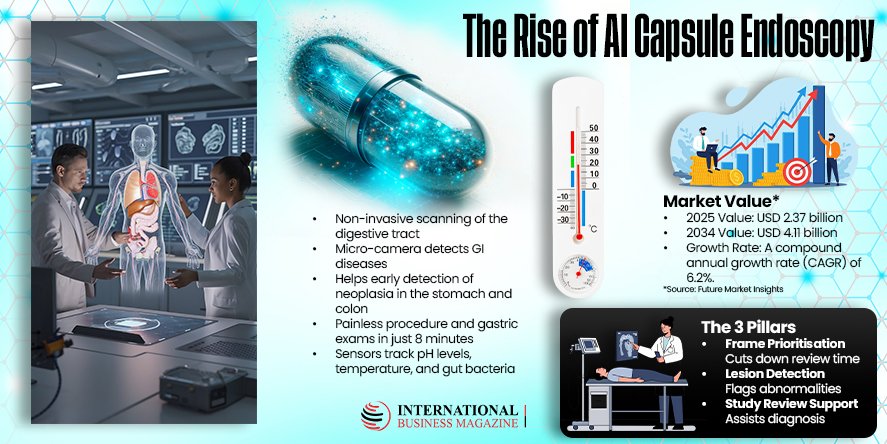
- Rapid Stomach and Bowel Exams: Swallowed camera capsules have the ability to complete full gastric exams in as little as 8 minutes without tubes or sedation, guided externally by magnetic robots.
- Automated Image Analysis: Sophisticated artificial intelligence systems discard repetitive video footage and pinpoint signs like sores, growths, and early cancers.
- Multimodal Sensing: Future versions of the capsule will include built-in sensors to track pH levels, temperature, gut bacteria, and signs of inflammation as they happen.
Targeted Drug Delivery and Therapeutics
- Smart Release Mechanisms: Advanced smart pills will control medication release speed, dispensing treatments like insulin or anti-nausea drugs when they detect specific body signals or inflammation.
- Personalized Interventions: Real-time information from the gut will let these medical devices instantly adjust treatments to match the body’s exact current state.
Global Market Size of AI Capsule*
The global AI capsule endoscopy reading platform market is estimated at USD 71.9 million in 2025 and is projected to reach USD 306.81 million by 2036, growing at a compound annual growth rate (CAGR) of 14.1%.
Regional and Country-Wise Market Breakdown
North America (Dominant Share: ~43% to 52%)
- United States: Holds the largest country-level share globally, supported by frequent FDA clearances for AI diagnostic tools, high healthcare spending, and robust reimbursement frameworks.
- Canada: Experiences steady growth driven by public healthcare adoption and specialist-driven gastrointestinal diagnostics.
Europe (Significant Share: ~27% to 28%)
Germany, UK, and France: This region is leading in medical technology adoption because of strong healthcare systems, government-supported cancer checks, and new smart testing tools.
Asia-Pacific (Fastest Growing Region)
China and Japan: Show fast growth due to large patient volumes, expanding domestic medical device manufacturing, and high familiarity with automated healthcare technologies.
Southeast Asia (Singapore, Thailand): Fast-emerging healthcare markets—exemplified by hubs in Thailand and Türkiye—are characterized by rapid expansion in organized private hospital infrastructure, high-volume and high-value medical tourism, and advanced, low-cost diagnostic capabilities.
Major Focus: The capsule endoscopy software market focuses on three main tools: frame prioritization to reduce review time, lesion detection to spot abnormalities, and study review support to help doctors make diagnoses.
Wider Context: The global Smart Pills Market is growing steadily as part of advanced digital healthcare.
Market Value*
- 2025 Value: USD 2.37 billion.
- 2034 Value: USD 4.11 billion.
- Growth Rate: A compound annual growth rate (CAGR) of 6.2%.
*Source: Future Market Insights
Conclusion
The AI Capsule is a practical design concept for smart spaces that merge advanced technology with human needs. From custom relaxation areas and smart offices to deep entertainment and connected travel, the possibilities are very large. Using new technology successfully requires more than just good engineering; it also depends on strong privacy, cybersecurity, fair pricing, easy access, low power use, and safe AI rules. Solving these problems allows AI Capsules to transform how we interact with technology and our surroundings.
Article by Baldeb Ram