
For centuries, global financial systems relied on slow, physical infrastructure. Legacy banking centered on paper banknotes, localized clearinghouses, and manual auditing. Moving money across borders required complex correspondent banking networks. These traditional or conventional methods created high transaction fees, counterparty risk, and multi-day settlement delays. To counter the same and with modern technology advent, cashless global economy has become the phenomenal force. The following are the pointers that are core for this cashless global economic shift to be a core force: –
1. The Macroeconomic Catalyst: The Silent Revolution in Global Commerce
The global financial landscape is undergoing its most profound transformation since the invention of paper currency. Physical banknotes and coins—once the undisputed lifeblood of everyday commerce—are steadily yielding ground to real-time, software-driven monetary networks. This phenomenal migration towards a cashless paradigm is not merely a matter of consumer preference; it represents a fundamental restructuring of business architecture, monetary policy, and global economic access.
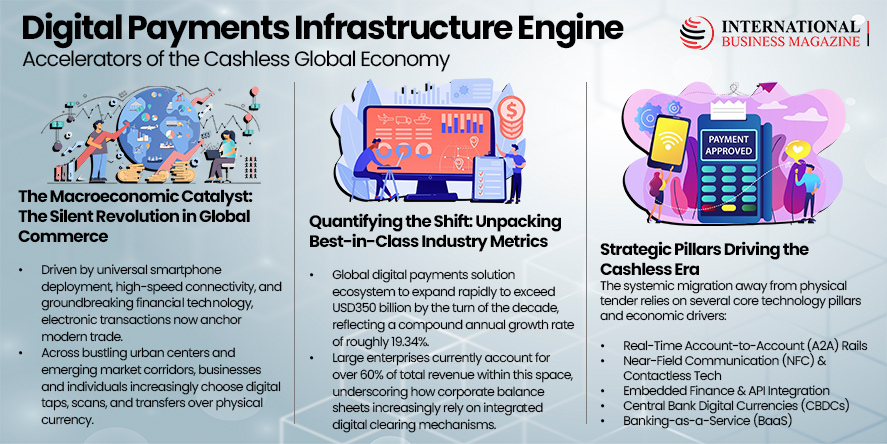
Driven by universal smartphone deployment, high-speed connectivity, and groundbreaking financial technology, electronic transactions now anchor modern trade. Across bustling urban centers and emerging market corridors, businesses and individuals increasingly choose digital taps, scans, and transfers over physical currency. This behavioral shift accelerates capital velocity, reduces operational friction, and provides unprecedented clarity into cash-flow dynamics for enterprises worldwide.
As central banks, enterprise leaders, and fintech pioneers collaborate to build interoperable global rails, the vision of a frictionless monetary ecosystem moves from strategic ambition to daily reality. Understanding this evolution is no longer optional for business decision-makers; it is the cornerstone of future-proof enterprise strategy.
2. Quantifying the Shift: Unpacking Best-in-Class Industry Metrics
To grasp the full momentum behind this transformation, executives must evaluate the empirical metrics shaping market trajectory. Quantitative analysis reveals an industry expanding at a phenomenal rate, backed by aggressive institutional capital and sovereign support.
Industry intelligence projects the global digital payments solution ecosystem will expand rapidly to exceed $350 billion by the turn of the decade, reflecting a compound annual growth rate of roughly 19.34%. Large enterprises currently account for over 60% of total revenue within this space, underscoring how corporate balance sheets increasingly rely on integrated digital clearing mechanisms.
Regionally, the Asia-Pacific territory commands the primary share of global value, driven by open-loop real-time interfaces such as India’s Unified Payments Interface (UPI) and China’s digital wallet infrastructure. Meanwhile, North America and Europe maintain steady, high-value transaction momentum, heavily backed by tokenization standards, regulatory frameworks, and rapid contactless payment terminal upgrades.
3. Strategic Pillars Driving the Cashless Era
The systemic migration away from physical tender relies on several core technology pillars and economic drivers:
- Real-Time Account-to-Account (A2A) Rails: Sovereign payment systems enable instantaneous clearing between institutions. By bypassing traditional card networks, these rails significantly lower settlement cycles and transaction costs for merchant networks.
- Near-Field Communication (NFC) & Contactless Tech: The proliferation of contactless point-of-sale terminals and wearable devices makes micro-transactions effortless, directly elevating retail throughput and consumer spending speed.
- Embedded Finance & API Integration: Modern corporations actively integrate banking capabilities directly into non-financial applications. Through seamless application programming interfaces (APIs), e-commerce platforms offer instant checkout, contextual credit, and point-of-sale financing effortlessly.
- Central Bank Digital Currencies (CBDCs): Monetary authorities across major economies are engineering sovereign digital tokens. CBDCs aim to lower cross-border remittance costs, eliminate intermediary risks, and strengthen sovereign financial stability.
- Banking-as-a-Service (BaaS): Banking-as-a-Service (BaaS) platforms allow non-bank enterprises to embed financial capabilities into their core software workflows. Analysts project the global BaaS market will surpass $120 billion by 2035, growing over 17% annually. This infrastructure enables non-financial brands to deliver digital wallets, branded card issuance, and instant lending features directly.Regional leaders demonstrate the rapid global scale of BaaS deployment across major economic corridors.
Examples of Global BaaS Ecosystem:
- In Europe, Solaris leverages full banking licenses to offer white-label accounts and compliant cross-border payment rails.
- In North America, platforms like Unit power seamless API integrations for corporate software companies and fintechs.
- Meanwhile, APAC players like Airwallex and GrabFin deliver embedded treasury, multi-currency accounts, and digital wallets across emerging markets.
4. The Corporate Imperative: Unlocking Value Beyond Convenience
For corporate CFOs, treasurers, and operations executives, transitioning away from physical tender yields far more than transactional ease. Digital payments deliver structural efficiencies that directly optimize bottom-line performance:
- Enhanced Working Capital Management: Real-time transaction settlement removes the drag of delayed float. Enterprise treasuries gain real-time visibility into cash positions across multi-currency accounts, optimizing liquidity management and reducing short-term borrowing costs.
- Drastic Reduction in Operational Costs: Handling physical cash entails exorbitant expenditure—including secure transit logistics, insurance, manual auditing, and reconciliation error resolution. Automated digital ledgers eliminate these operational overheads while maintaining meticulous audit trails.
- Data-Driven Customer Insights: Digital settlement architectures generate rich, structured transaction datasets. Corporate strategists leverage artificial intelligence to analyze purchasing patterns, personalize loyalty programs, dynamic pricing structures, and predict inventory demand with high precision.
5. Overcoming Friction: Security, Governance, and Inclusion
Despite its compelling trajectory, the transition toward a fully cashless economy demands deliberate solutions to complex operational risks:
- Cybersecurity Threats: Rapid digitization exposes financial networks to sophisticated account takeover fraud, phishing tactics, and automated bot attacks. Enterprises must implement AI-driven fraud detection algorithms and robust biometrics to protect assets.
- Regulatory Harmony: Cross-border transactions often encounter fragmentation due to disparate anti-money laundering (AML) and know-your-customer (KYC) requirements across international jurisdictions.
- Financial Inclusivity: Broadening digital infrastructure access ensures remote populations and unbanked demographics participate fully in the modern economy.
Addressing these challenges requires continuous collaboration between policymakers, corporate entities, and cybersecurity specialists to establish standardized, resilient, and inclusive global protocols.
6. Core Technological Foundations
Modern banking methodology relies on Open APIs to embed payment tools directly into business platforms. These software interfaces reduce checkout friction and enable dynamic real-time liquidity tracking.
Blockchain technology and regulated stablecoins revolutionize cross-border corporate settlements. They enable instant, 24/7 international value transfers while eliminating costly correspondent bank intermediaries.
Cross-border inclusion tools now connect localized digital wallets globally. These interoperable networks allow small enterprises to access international buyer markets effortlessly.
Pioneering the Next Frontier of Digital Commerce
The acceleration of digital payments marks a permanent evolution in how human civilization exchanges value. As smart contracts, tokenized assets, and real-time cross-border networks mature, the boundaries between money and software will continue to dissolve. Forward-thinking organizations must proactively upgrade their technology stacks, champion secure payment protocols, and optimize their financial infrastructure. By positioning their enterprises at the forefront of this revolution, executive leaders build adaptive, transparent, and resilient institutions ready to thrive in a cashless world.
Blog by Medhaj Nair