
Cyber resilience combines security and continuity. It allows organisations to maintain operations and deliver results with little to no downtime during disruptions.
Cybersecurity and cyber resilience go hand in hand. Cyber resilience is the natural partner to cybersecurity. Cybersecurity protects systems and data from digital attacks. However, this defence alone is not enough. Cyber threats grow more complex which leaves businesses, organisations and individuals exposed.
In the modern digital age, cyber threats are not occasional technical disruptions but constant storms battering the security walls of every organisation. Hackers, ransomware operators, and state-sponsored adversaries probe relentlessly, searching for weaknesses to strike the soft under belly by using bots, chatbots and mainstream AI models to generate malicious code. Hackers use bots to send targeted emails, create convincing fake websites, or distribute malicious links across social platforms. Yet resilience is not about avoiding the storm – it is about standing tall within it, defending critical assets, recovering swiftly, and learning continuously.
The cyber resilience journey begins with readiness. To prepare for battle, organisations need to map their attack surfaces with precision. Every server, endpoint, cloud application, and mobile device is a potential doorway for attackers. Shadow IT, those unauthorised apps and devices that slip into daily operations, often expand the battlefield without notice. By cataloguing assets and tracking threat intelligence, companies gain visibility into evolving dangers. Threat feeds reveal the latest malware strains and zero-day exploits, while penetration testing and red-team (authorised, realistic simulations where an offensive security team acts as an adversary to test an organisation’s detection, response, and overall security posture) exercises expose weaknesses before adversaries do. Readiness is the key to tackle Cyber threat and stay strong.
What the experts Find
The World Economic Forum’s latest report underscores how cyberspace has become inseparable from geopolitics, the global economy, and everyday life. Recent incidents – ranging from retail and manufacturing disruptions to aviation delays, public‑sector intrusions, and hyperactive scale cloud outages – have revealed the fragility of these digital connections. A single fault can now cascade into global consequences. In 2026, cybersecurity is evolving across technological, geopolitical, and strategic dimensions. The year will test preparedness and the ability to align policy, ethics, and collaboration in defending a digital world.
Over five years, the Forum’s Global Cybersecurity Outlook has tracked a shift from pandemic‑era urgency to systemic risks like AI acceleration and geopolitical fragmentation. Its 2026 edition emphasises one dominant theme: collaboration is indispensable. Cyber resilience integrating continuity, security, and organisational strength – remains the cornerstone of digital defence.
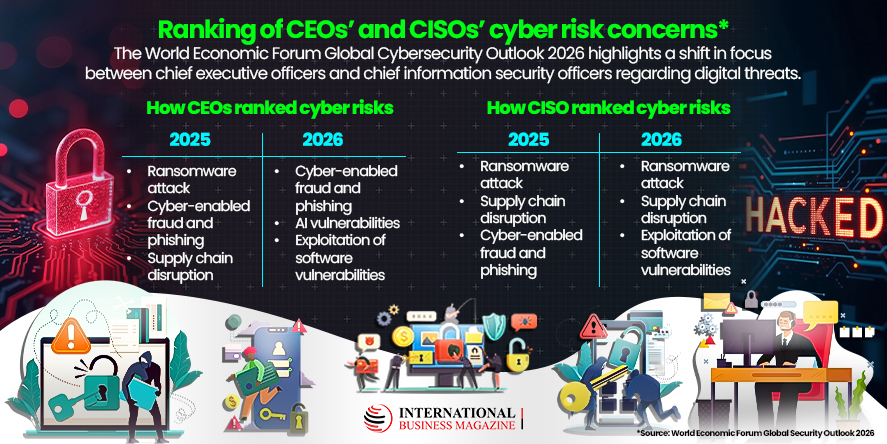
The World Economic Forum Global Cybersecurity Outlook 2026 highlights a shift in focus between chief executive officers (CEO) and chief information security officers (CISO) regarding digital threats. The perception of cyber risk at the highest levels of leadership has undergone a notable transformation between 2005 and 2006.
For CEOs, the primary concern shifted from operational gridlock to deceptive and emergent technological vectors. In 2025, chief executives ranked ransomware attacks as their primary worry, followed by cyber-enabled fraud and phishing, and supply chain disruption. By 2026, cyber-enabled fraud and phishing surged to the number one spot, accompanied by growing anxieties over artificial intelligence vulnerabilities and the exploitation of software vulnerabilities. In contrast, CISOs remained anchored on operational infrastructure and foundational system threats. For both 2025 and 2026, chief information security officers maintained ransomware attacks and supply chain disruptions as their top two critical concerns. Their third-place priority shifted from cyber-enabled fraud and phishing in 2025 to the exploitation of software vulnerabilities in 2026, demonstrating a steady focus on technical remediation and defensive posture.
Artificial Intelligence Security Anxieties
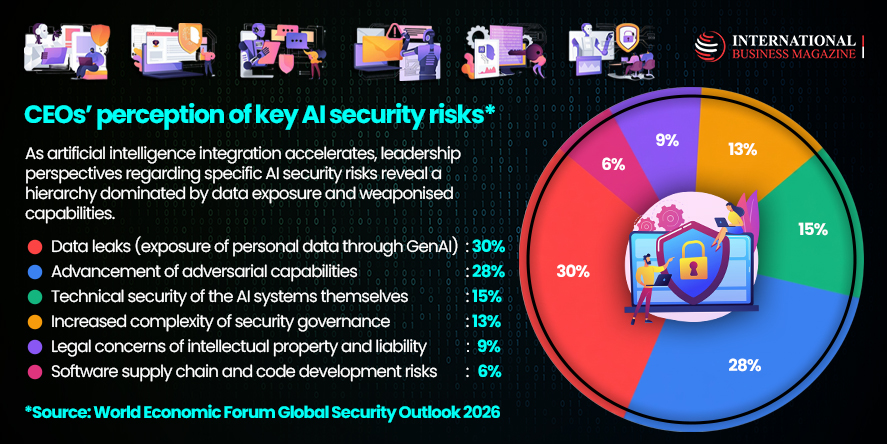
As artificial intelligence integration accelerates, leadership perspectives regarding specific AI security risks reveal a hierarchy dominated by data exposure and weaponised capabilities. Data leaks involving the exposure of personal information through generative AI represent the single largest fear at 30 per cent, closely followed by the advancement of adversarial capabilities at 28 per cent. Technical security concerns regarding the AI systems themselves capture 15 per cent of the perceived risk, while the increased complexity of security governance accounts for 13 per cent. Trailing this core operational anxieties are legal concerns regarding intellectual property and liability at 9 per cent, with software supply chain and code development risks rounding out the perception spectrum at 6 per cent.
According to another global survey of 1,200 security professionals, rising ransomware threats require enhanced visibility and lateral movement restrictions, rendering traditional firewalls insufficient. Microsegmentation has emerged as a vital Zero Trust component. While 90% of organisations use basic segmentation, only 35 per cent have implemented microsegmentation, the researchers noted.
Resilience is about holding the line
These findings are a revelation and pointers to understand the importance of cyber resilience.
When the attack inevitably comes, resilience demands defence in motion. Panic is the enemy; structure is the shield. Network segmentation ensures that if one system falls, others remain secure, preventing attackers from moving laterally across the enterprise. Access controls, built on the principle of least privilege, limit exposure by ensuring employees only reach what they truly need. Multifactor authentication and role-based permissions add layers of defence against stolen credentials. Incident response playbooks, rehearsed and refined, guide teams through chaos, ensuring communication is clear, systems are isolated, and damage is contained. In this phase, resilience is about holding the line – keeping core business functions running safely even under siege.
Defence alone, however, is insufficient. The true test of resilience lies in recovery. Systems are damaged, data lost, but the resilient organisation rises quickly. Isolated backups, stored offline or in secure environments, remain immune to ransomware encryption. Tested restoration procedures ensure quick recovery of data. Disaster recovery drills prepare teams to rebuild under pressure, transforming panic into practiced response. Business continuity planning is the key to ensure seamless customer services, supply chains, and communications with minimal disruption. Customers and partners judge organisations by how swiftly and transparently they recover with minimal damage.
Resilience goes beyond recovery. Every disruption carries lessons, and the resilient organisation learns and adapts. Post-incident reviews reveal how adversaries gained entry, what defences failed, and what strategies succeeded. These insights translate into updated security policies, tighter access controls, enhanced monitoring, and revised vendor risk management. Security architectures evolve alongside technology trends – cloud adoption, remote work, and AI-driven systems demand new defensive designs. Resilience is cyclical: readiness, defence, recovery, and adaptation feed into one another, creating a loop of continuous improvement. Being transparent during ransomware attack is crucial. To understand the criticality of transparency the following example is a good pointer.
Real-World Example: Norsk Hydro (2019)*
Hackers hit Norsk Hydro with ransomware. The company responded with transparency. On March 19, 2019, Norwegian aluminium giant Norsk Hydro suffered a massive LockerGoga ransomware attack affecting 35,000 employees across 40 countries.
What happened: A massive ransomware attack isolated the global aluminium company’s entire network.
How did the company respond: Instead of paying, they switched to manual operations using printed blueprints.
The Outcome: They maintained production, transparently updated the public, and recovered fully via backups.
*Source: Microsoft
The Decisive Role of Human Touch
Technology alone cannot guarantee resilience. The human element – employees, leadership, and culture – plays a decisive role. Cyber hygiene training empowers staff to recognise phishing attempts and suspicious links. Here, resilience is an asset and not a cost. Furthermore, a culture of vigilance, transparency, and learning embeds resilience across the organisation, making it a shared responsibility rather than a siloed function.
Ultimately, cyber resilience is more than survival – it is a strategic imperative. Organisations that demonstrate resilience attract trust, investment, and loyalty. In a digital economy, resilience is the currency of credibility.
The final take: Cyber threats will never vanish; they will only grow more sophisticated. However, resilience transforms fear into strength. By mapping attack surfaces, tracking intelligence, preparing for vulnerabilities, segmenting networks, enforcing access controls, restoring systems with tested backups, and evolving policies after disruptions, organisations stand strong in the digital storm. Cyber resilience is not a destination – it is a journey. It is the art of staying strong, defending wisely, recovering swiftly, and learning continuously. In the end, resilience is not just about protecting data – it is about protecting trust, reputation, and the very heartbeat of modern business.
Article by Imtiaz Ahmed Shariff