
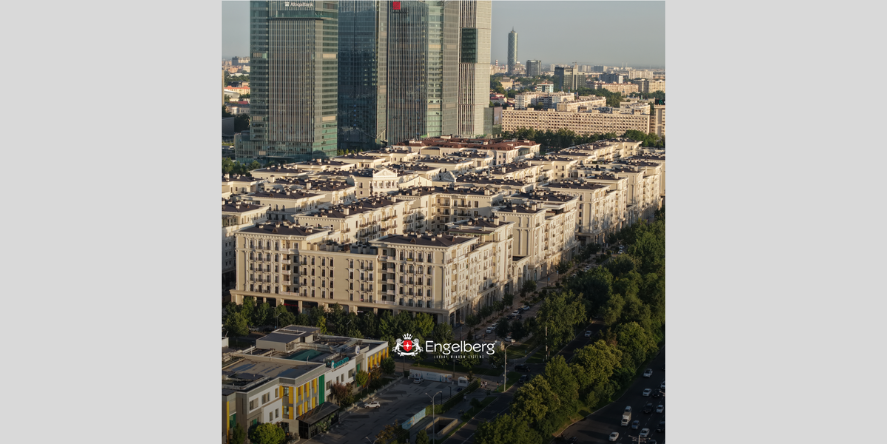
A Luxury Window Systems brand from Tashkent rests its work on three pillars: its own view of what a window should be, an individual approach to every project, and technology-driven manufacturing.
The Engelberg showroom does not display windows as profile samples on stands. The systems are installed full size: visitors can open and close them and compare hardware finishes and profile colours. A conversation with a client starts with the project, not the price list: the house, its openings, the direction the windows face, the façade.
That approach defines the brand. Engelberg has received an International Business Magazine Award in the “Best Window Systems for Premium Residential Architecture – Globe 2026” category for its window and sliding systems for private residences, villas, premium apartments and boutique hotels.
The Window as Part of the Architecture
Engelberg positions itself as Luxury Window Systems, a premium window systems brand. Its starting point is simple: the window determines how much light a home gets, how quiet a bedroom above a busy street is, what the living room looks out on and how the façade reads from outside. For Engelberg, then, a window is not standard building equipment but part of the architecture. The brand works with architects, developers and private owners wherever demands run higher than usual: large openings, panoramic glazing, strong thermal and acoustic insulation, precise geometry and a profile colour matched to the façade.
Hence the values the brand rests on: precise workmanship, durability, an aesthetic without superfluous detail, and responsibility for how the window performs over years of use. The slogan “Creating a New Way of Living” expresses the same idea: a window should work with the architecture, the interior and the view.
A Distinctive Approach
Every Engelberg project begins with selecting a system for the specific building, taking into account the size and type of opening, wind loads, thermal and acoustic requirements, climate and façade colour. A city apartment might call for the six-chamber Engelberg 80; a villa with mountain views, the aluminium Thermo 98 with panoramic glazing; a garden exit, the BKH 65 sliding system. The Central Asian climate gets particular attention, with summer highs of +50 °C, winter frosts and sharp swings between day and night: Engelberg profiles are designed to withstand prolonged sun and thermal deformation.
The brand pays equal attention to the details an owner sees and touches every day. The handle is touched more than any other part, so its design and finish are chosen as carefully as the profile colour. Hardware from leading European manufacturers comes in black, bronze, gold-tone and chrome finishes. Profiles are offered in laminated finishes and in the metallic Metalux collection, including Alux Anthracite, so the window can match the palette of façade and interior.
The same approach works beyond Uzbekistan; Engelberg systems have long been supplied to Europe. For a private residence in the Netherlands, the architect envisaged a minimalist house with deep openings and panoramic windows facing a pine forest. The choice was Thermo 98 in Alux Anthracite: the system stands up to north-western European wind and rain, and the dark profile emphasises the depth of the openings while complementing the wood and concrete of the façade. At home, the brand is expanding its network of showrooms where customers can see the systems and place orders; in 2026 new showrooms opened in Tashkent and Khiva. In February 2026 Engelberg presented its aluminium and PVC systems at the 27th UzBuild international exhibition in Tashkent.
Technology
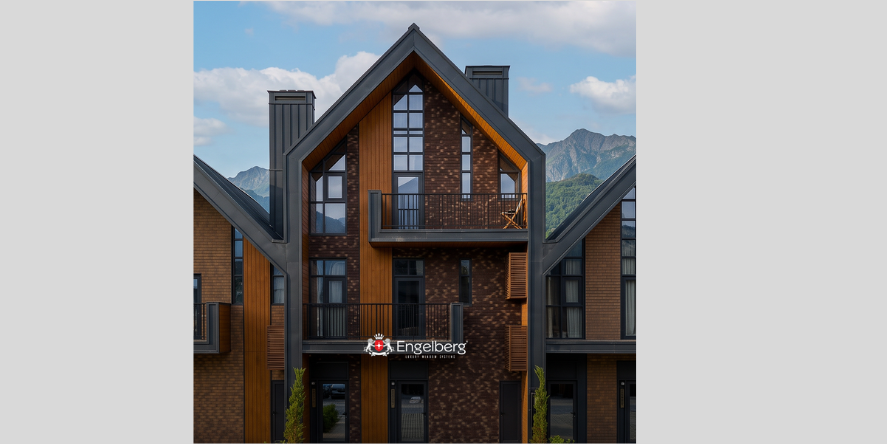
Behind the outward simplicity of Engelberg windows lies high-tech manufacturing. The systems are produced on automated lines using European technology and high-precision equipment. Automation removes the human factor where it matters most: in large-format units. Multi-level quality control follows each product through every stage of production, up to testing of the finished unit.
In September 2026 a new line began producing insulated glass units up to 6,000 × 3,000 mm. For panoramic residential architecture, where glass becomes the main material of the façade, this means glazing on a new scale. The line expands local production of large-format glass units for contemporary façade and architectural projects.
The systems are built on the brand’s own patented technologies. Thermal insulation comes from foamed polyethylene inserts, a 54 mm thermal break and two-component seals. The flagship systems accept glass units up to 52 mm thick, so a single unit can combine energy-saving and solar-control glass with laminated safety glass.
Each system is tested in the laboratory as a complete assembly rather than component by component: strength, airtightness, wind-load resistance, thermal insulation and noise protection are checked under near-extreme conditions. All systems are designed for the Central Asian climate, and the flagship systems operate across a range of +50 °C to −40 °C. For the architect and the homeowner, this means a window behaves on site just as it did in the laboratory.
Systems for Every Task
The Engelberg portfolio covers both key materials. The PVC systems Engelberg 70 and Engelberg 80 are designed for urban residences and apartments: the five-chamber Engelberg 70, with a 2.8 mm profile wall, withstands up to 60,000 opening cycles, while the six-chamber Engelberg 80 takes glass units up to 50 mm and sashes up to 2,300 × 1,000 mm weighing up to 80 kg.
The aluminium Thermo warm series comprises seven systems, from Thermo 57 to Thermo 105. Thermo 85, with an enlarged thermal break, is a versatile solution for private houses. The flagship Thermo 98, with a 98 mm installation depth and a polyamide thermal break, is designed for panoramic glazing and heavy wind and rain loads. Thermo 105, with a 105 mm sash depth, allows sashes up to three metres high, almost the full height of a storey. The BKH 65 panoramic sliding system and curtain-wall façade systems complete the range.
Engelberg in the City
The brand’s values extend beyond its products. Since 2025 Engelberg has staged the Engelberg Opera Festival, an annual event that takes opera out of theatre halls and into Tashkent’s parks and public spaces. The second season opened on 9 May at Seoul Mun and Tashkent City Park and ran all month. It featured musicians from the Alisher Navoi State Academic Bolshoi Theatre, students of the State Conservatory of Uzbekistan and Bravo Orchestra. A choir and orchestra even performed at Tashkent International Airport, and the season closed with an open-air gala concert in Tashkent City Park. According to the organisers, the concerts and flash mobs drew more than 200,000 spectators.
The logic is the same as in the product: Engelberg is concerned with the quality of the environment people live in, whether that is the view from a living-room window or the sound of a familiar city square.
What Comes Next
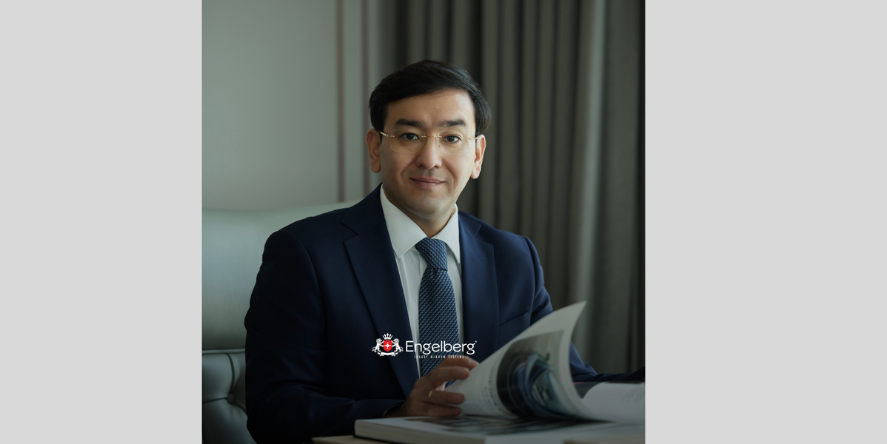
“We make windows for homes where the demands on them are highest: in the size of the opening, in warmth, in quiet and in appearance. This award confirms that systems made in Uzbekistan meet the world standard for premium residential architecture.” — Sanjar Umatov, Head of the Engelberg brand
The brand’s immediate plans centre on systems for panoramic architecture, production of large-format glazing, wider supply geography and a growing showroom network. The aim remains the same: a window made in Tashkent should perform with equal precision in a city apartment, a country villa and on a European façade.
Article received via email